From knapped flint to chardonnay
Dompierre and Becquincourt went through the centuries side by side before becoming one in 1964. Here is their history, era by era.
Dompierre means "Saint Peter"
The name appears in texts from the 12th century: Domnapetra in 1119, Donpierre in 1145, Domni Petra in 1219, then Dompierre in 1301. The prefix Dom- comes from Late Latin domnus, "lord", a title given to saints: Dompierre is therefore simply Saint Peter, patron of the priory and the church.
Local tradition has long read Domus Petri, “the house of Peter”. The two readings meet: the village grew up around a sanctuary dedicated to the apostle, probably as early as the Carolingian period. But the question remains open: the many Gallo-Roman sanctuaries spotted from the air by Roger Agache suggest that the place was already an important religious centre long before the priory. There are, incidentally, about twenty Dompierres in France, united in the association of the Dompierre de France, of which our commune is a member.
Becquincourt, the estate of Becco
Becquincourt is written Bechincourt in 1143, Bekincort in 1188, Bequincourt in 1579. The ending -court (Latin curtis) means a farmyard, then a rural estate; the first part would be the name of a Germanic owner, Becco or Bicco. A typical name of the Frankish estates of the early Middle Ages, so numerous in Picardy.
Three names for one commune
- Until 1924
- Dompierre
- 1924 – 1964
- Dompierre-en-Santerre
- Since 1964
- Dompierre-Becquincourt, after the merger with Becquincourt
- In Picard
- Dompierre-Béquincourt
The village in 1899. That year, the schoolteachers of Dompierre and Becquincourt each filled in a geographical and historical report on their commune. Facsimiles and full transcription (in French): Dompierre and Becquincourt as told by their schoolteachers.
The origins
Prehistory – Antiquity- Prehistory
Flints in every field
Ploughed fields and gardens in the village have always turned up knapped flints: the loam plateau of the Santerre, fertile and easy to farm, was settled very early.
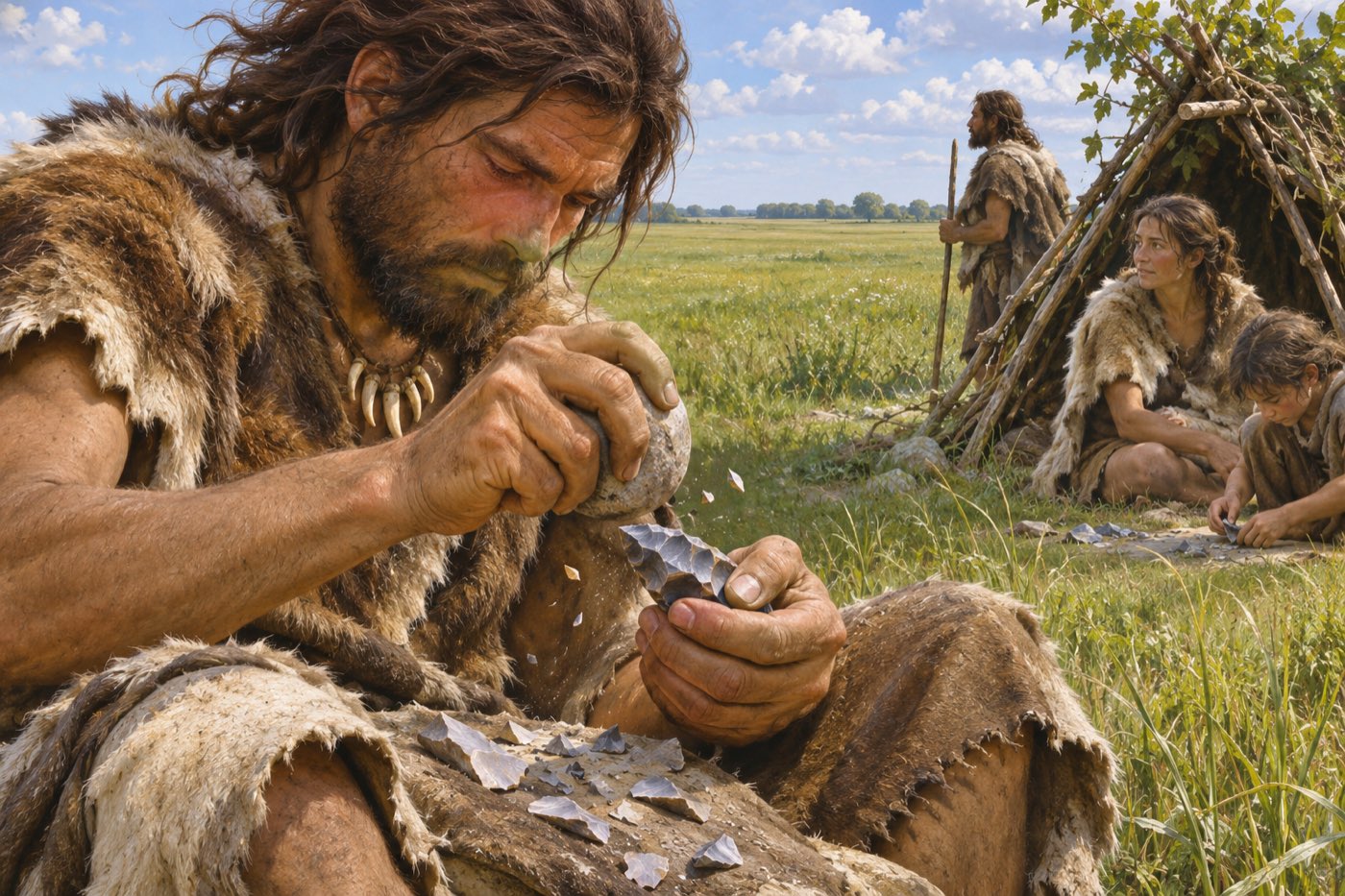
Flint knapping on the Santerre plain. Imagined illustration, not from the period. - Gaulish and Gallo-Roman era
Villas and sanctuary
Archaeology has revealed several villas on the territory — the large farms of the Roman era — as well as a fanum, a small temple of Celtic tradition. The Santerre was then one of the granaries of Gallia Belgica. These remains were spotted from the air by Roger Agache, a pioneer of aerial archaeology.
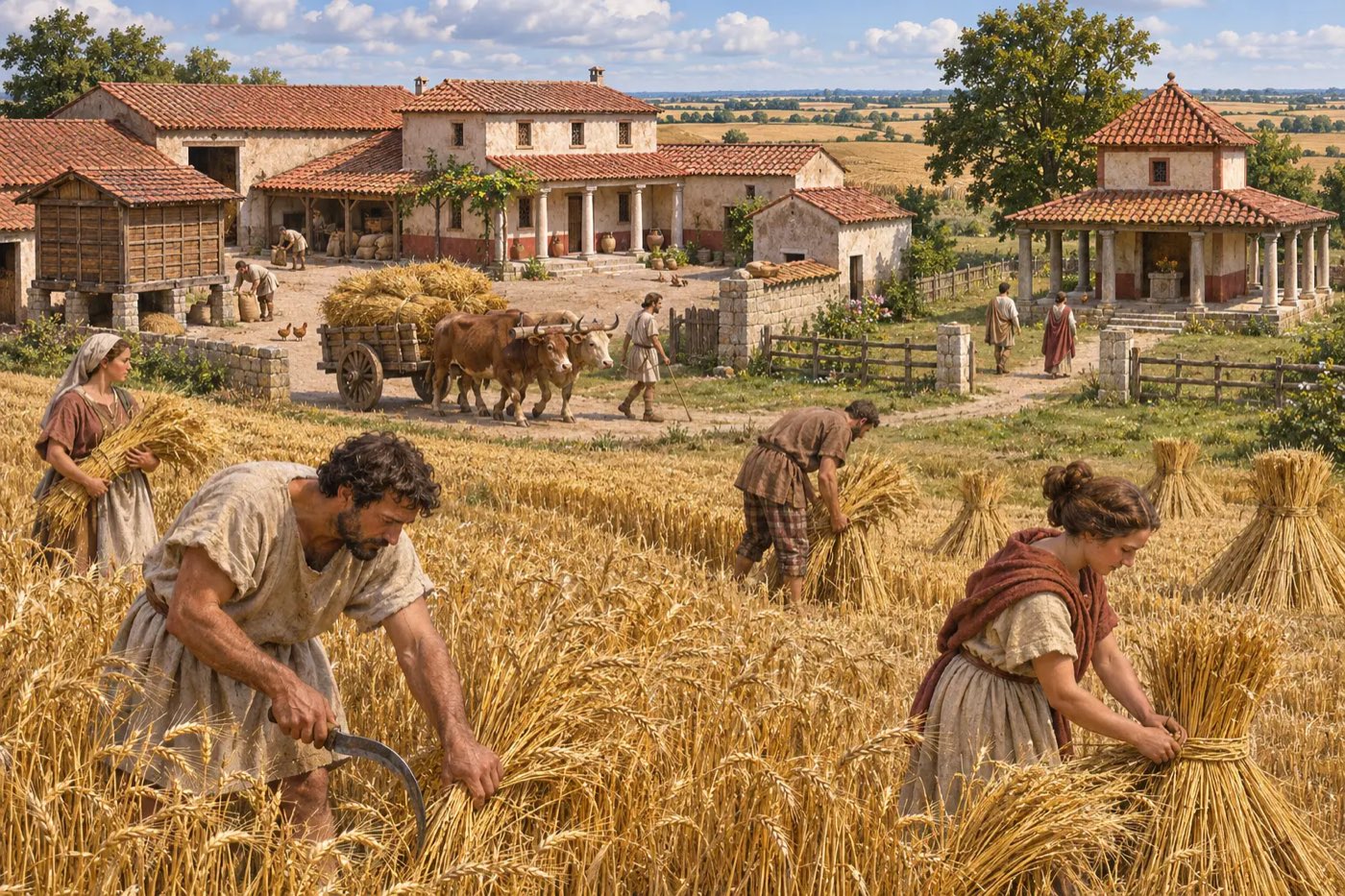
A Gallo-Roman villa at harvest time. Imaginary illustration, not from the period. - Early Middle Ages
The time of the Frankish estates
The name Becquincourt keeps the memory of an estate founded by an owner with a Germanic name, while that of Dompierre bears witness to a place of worship dedicated to Saint Peter, probably established in Carolingian times.
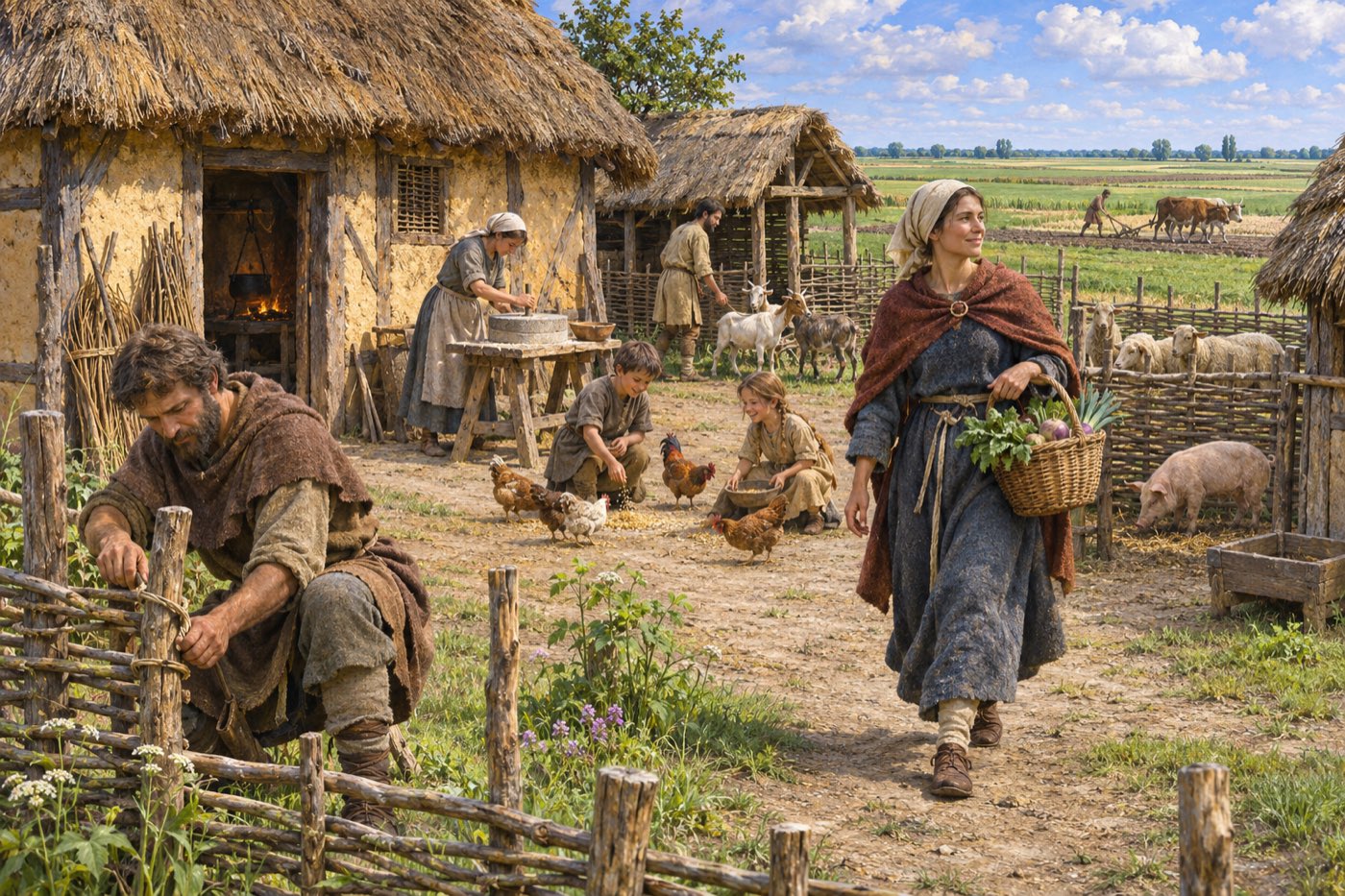
Life on a rural estate in the early Middle Ages. Imagined illustration, not from the period.
The Middle Ages
12th – 15th century- 1109
A Cluny priory
The priory of Dompierre exists from the first years of the 12th century: in 1109 it belongs to the powerful Burgundian abbey of Cluny.
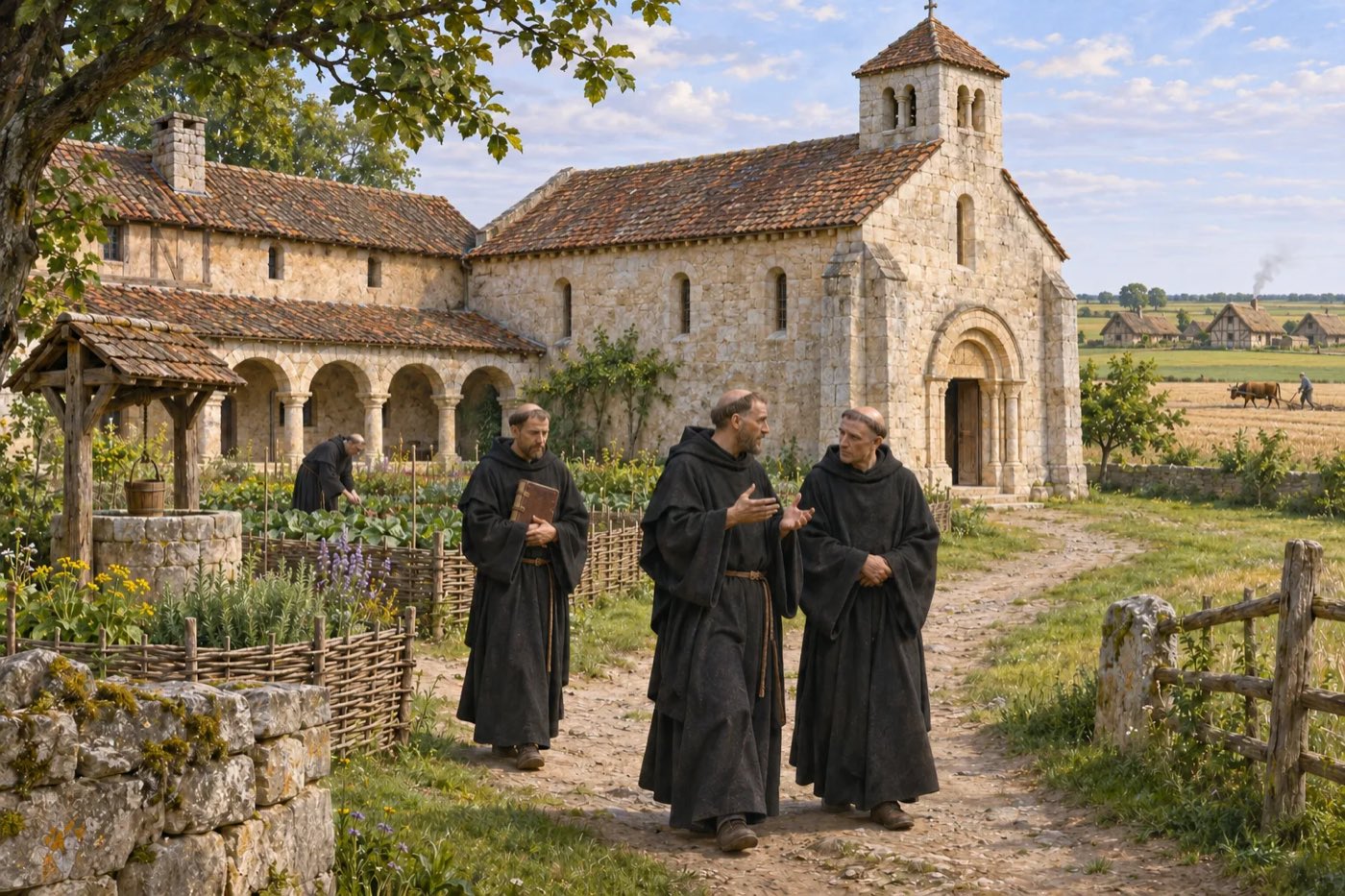
A Cluniac priory in the Middle Ages. Imaginary illustration, not from the period. - 12th century
Becquincourt under the counts of Vermandois
The neighbouring village then depends on the count of Vermandois; Countess Eleanor will be the last holder before its union with the Crown.
- 13th century
Abbots as lords
The abbots of Saint-Barthélemy become lords of Dompierre.
- 1383
From priory to large farm
The priory is turned into a vast farm — the first step of a calling that will never fade.
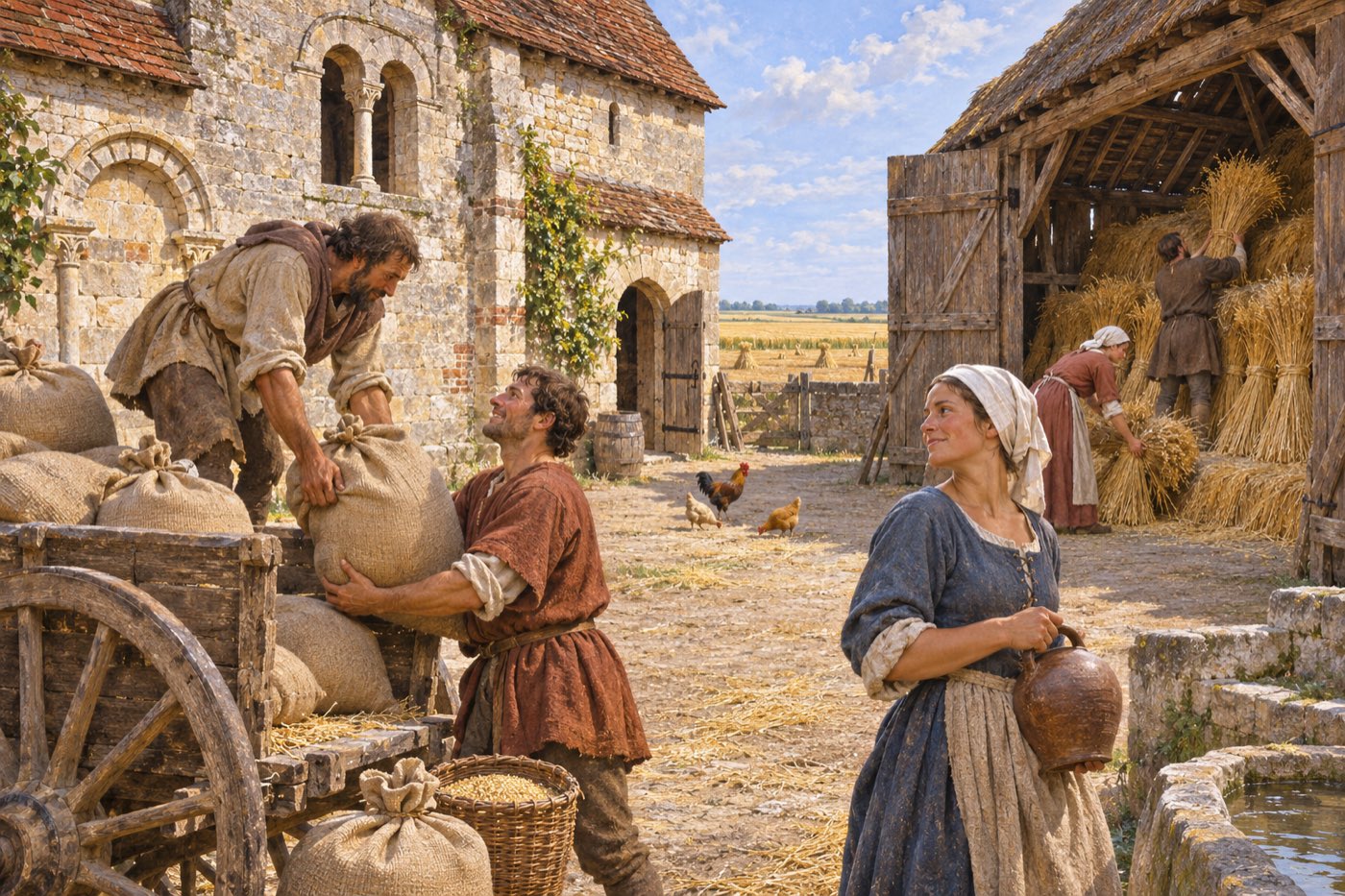
The farming vocation of a former priory. Imagined illustration, not from the period. - 1414
A Duke of Burgundy at the castle
John the Fearless, Duke of Burgundy, lodges at the castle of Becquincourt, in the midst of the civil war between Armagnacs and Burgundians.
The modern era
16th – 18th century- 1568 – 1589
The d'Humières, lords of Becquincourt
The castle belongs to the d'Humières family. Charles d'Humières, governor of Péronne in 1568, sees his lordship confiscated in 1589, at the height of the Wars of Religion, for having sided with Henri IV.
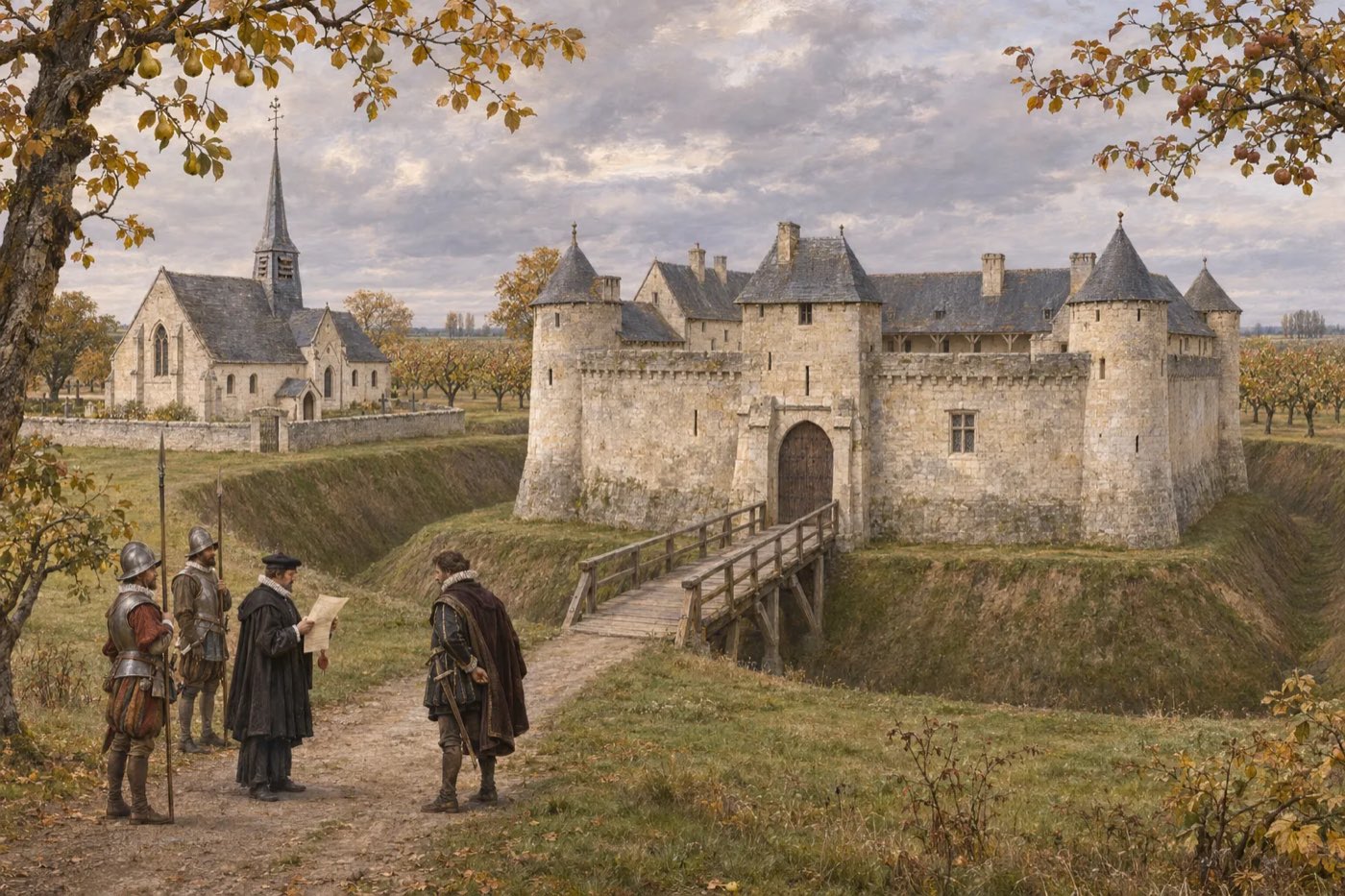
Becquincourt's fortified castle, with its moats, orchard and church beside it. Computer-generated illustration based on the plan alongside, the church drawing on the 1877 watercolour (further down the timeline). Not from the period. 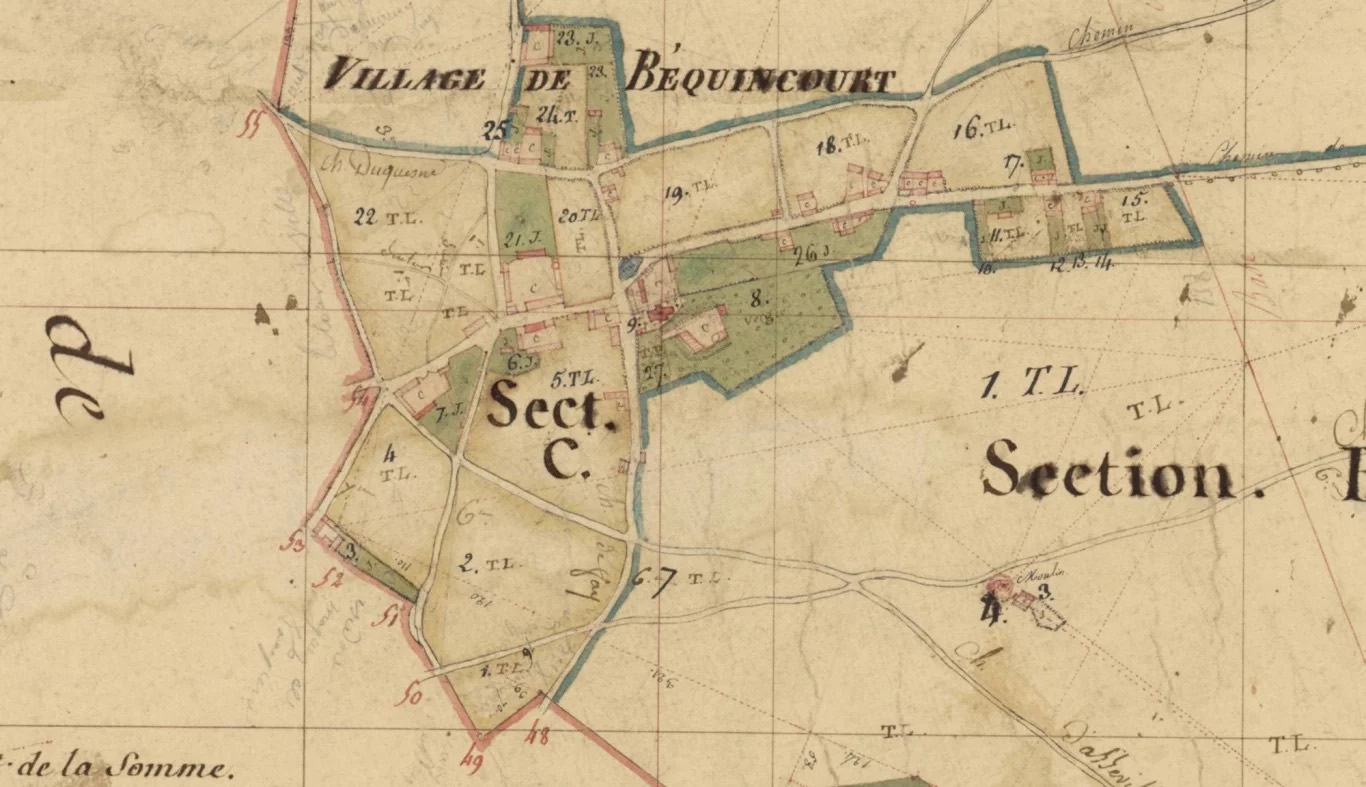
Old plan of the village of Becquincourt: the castle surrounded by its moats, its orchard and the church. Click to enlarge. - 1597
Fields left fallow
The war with Spain prevents ploughing: rents have to be reduced.
- Under Louis XIII
The fortress dismantled
The fortified castle of Becquincourt is destroyed. Its ruins will remain visible until 1872.
- 1632 – 1634
The passing of troops
The soldiers of the Count of Soissons, quartered at Cappy, live off the land; rent reductions again have to be granted to the tenant farmers.
- 1689 and 1707
The first schools
A school is recorded in Dompierre as early as 1689, and a schoolmaster in Becquincourt in 1707.
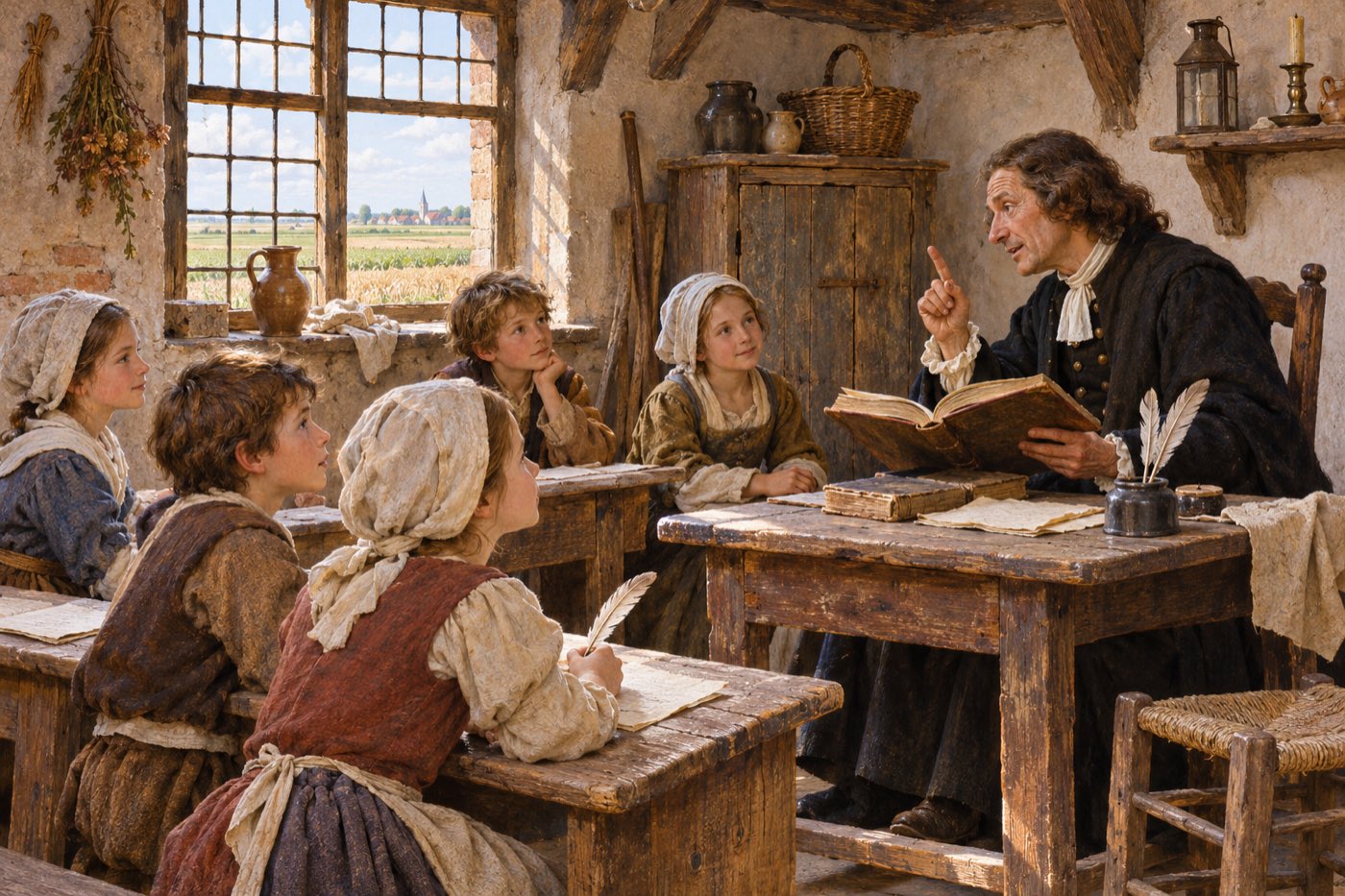
A rural school around 1700. Imagined illustration, not from the period. - 1695
The Maladrerie
The former leper hospital then owns 62 hectares of land in the parish.
The 19th century
1814 – 1900-
“Napoleonic” cadastre
The village drawn plot by plot
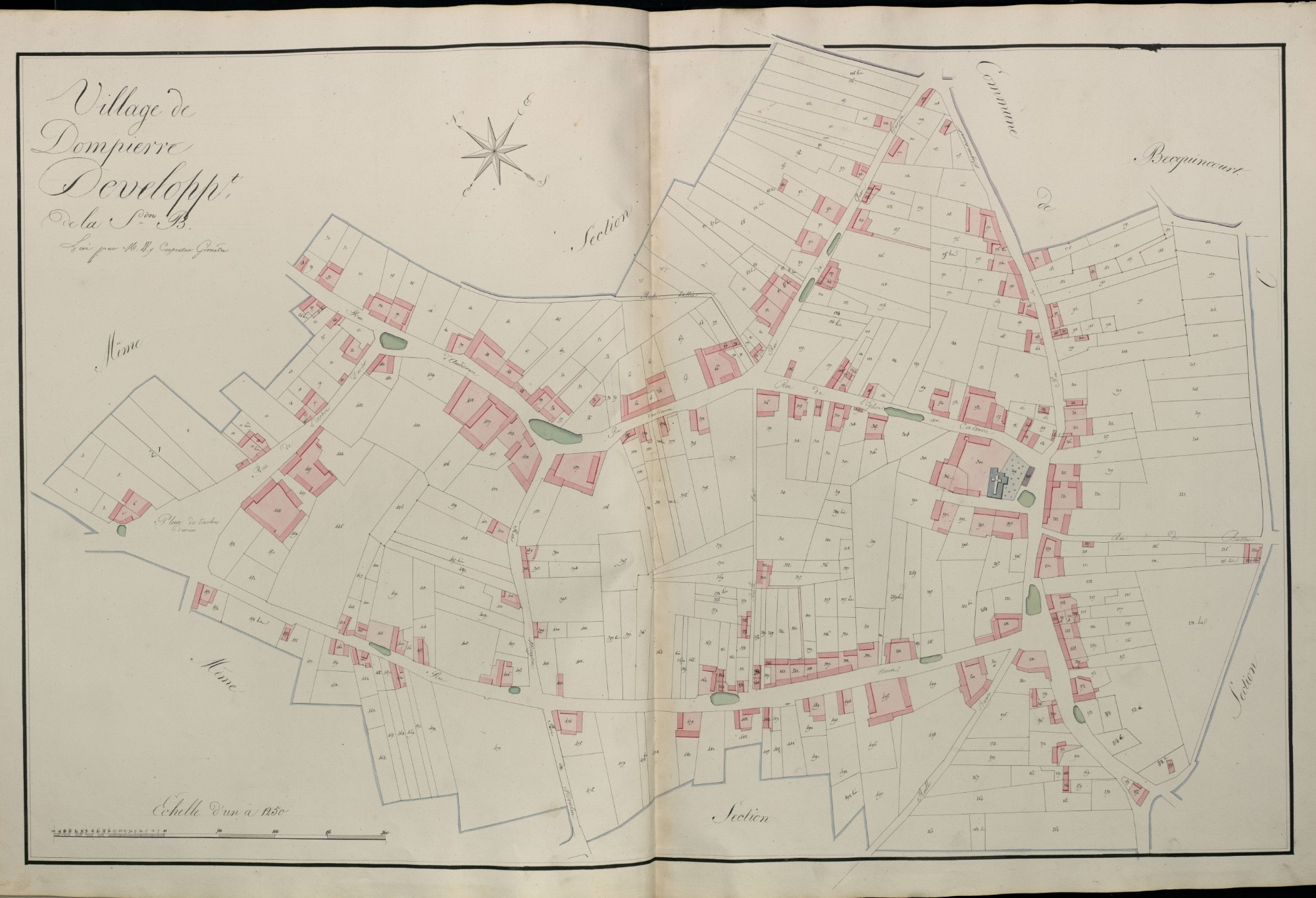
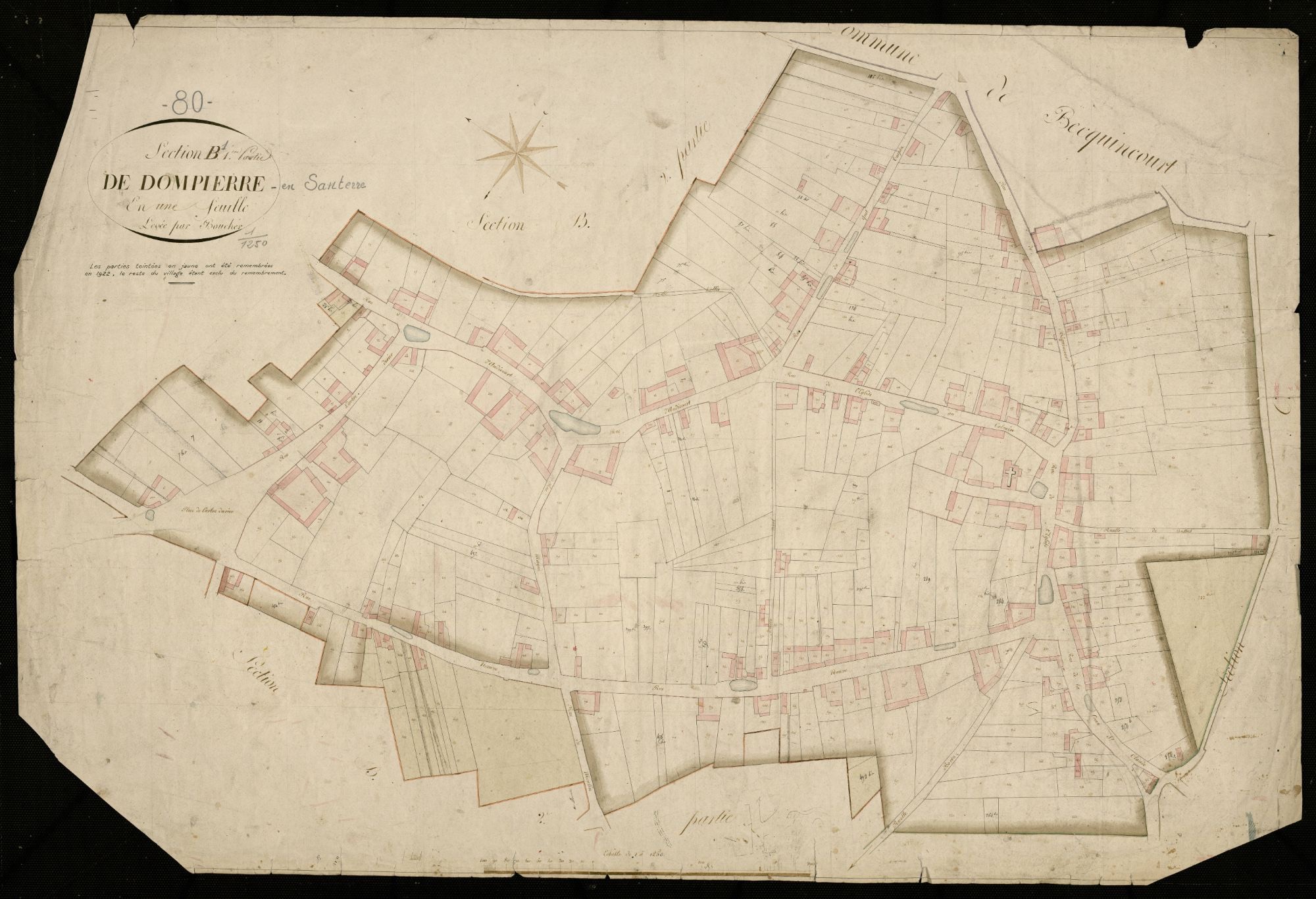
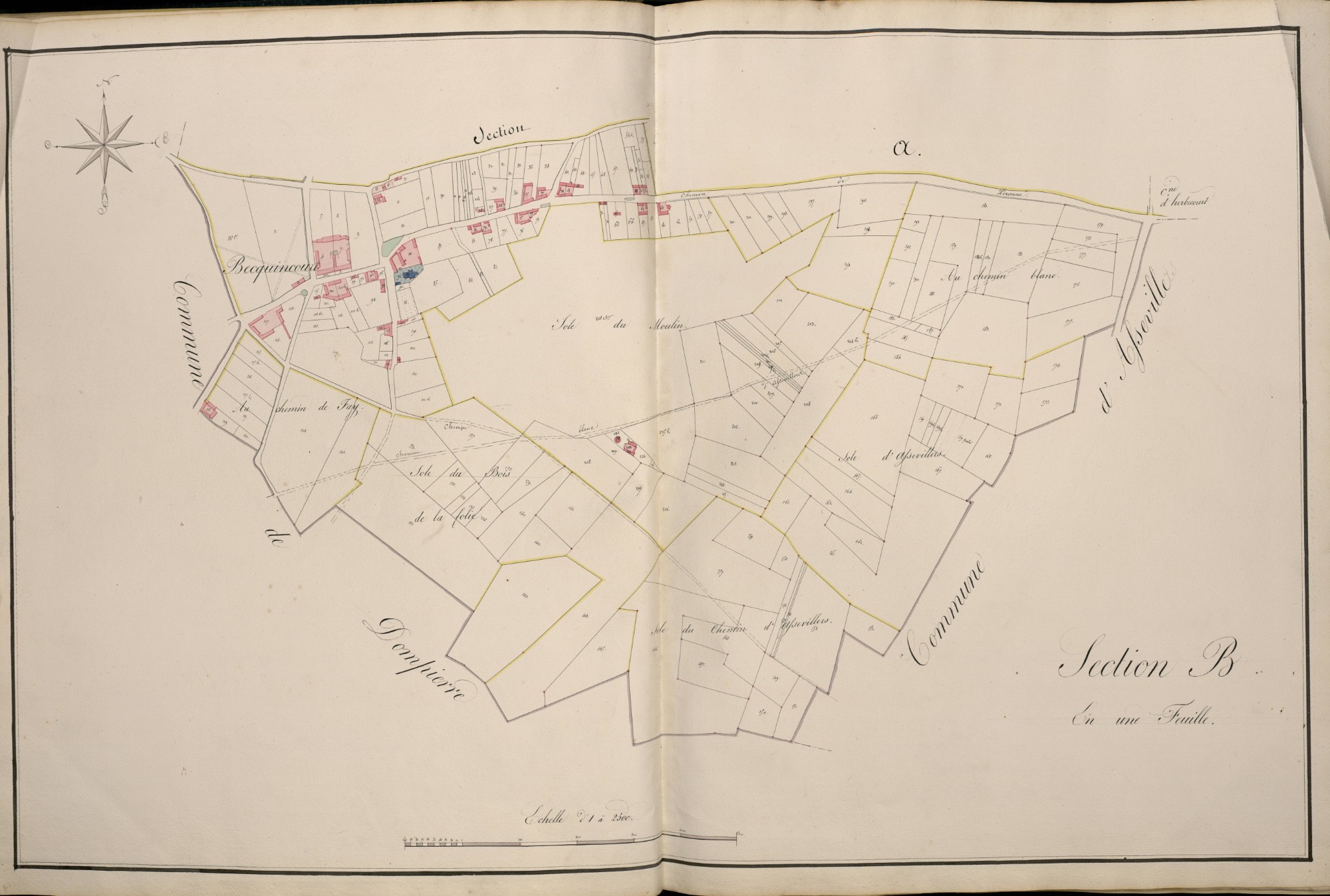
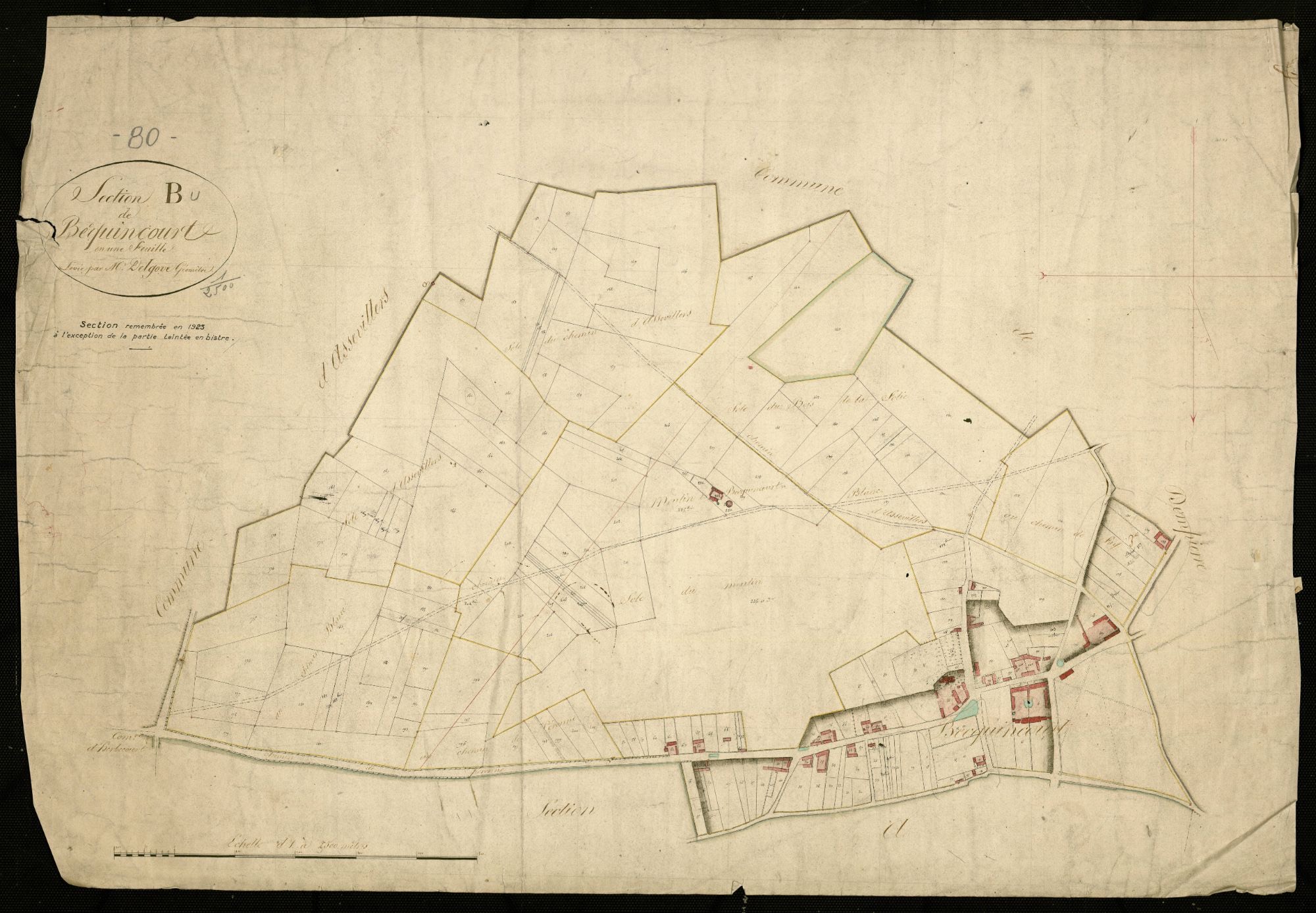
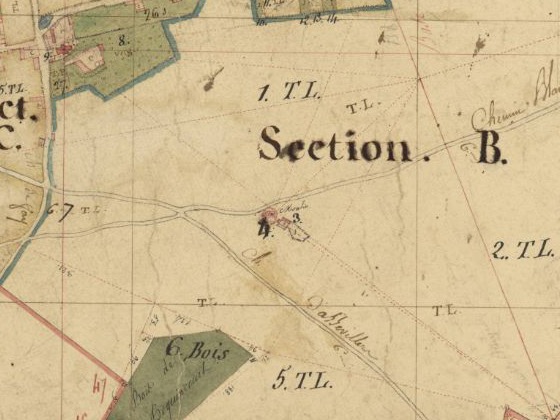
In the 19thcentury, surveyors drew up a plan of each commune, house by house and field by field. Buildings are in pink and ponds in green, and the church and its graveyard are shown at the heart of the village. The names of the “soles” (Sole du Moulin, Sole du chemin d'Assevillers…) recall the old three-year crop rotation. After the war these plans were updated: on the revised sheets, the areas reorganised in 1922 and 1923 are tinted yellow or bistre. Click an image to enlarge it.
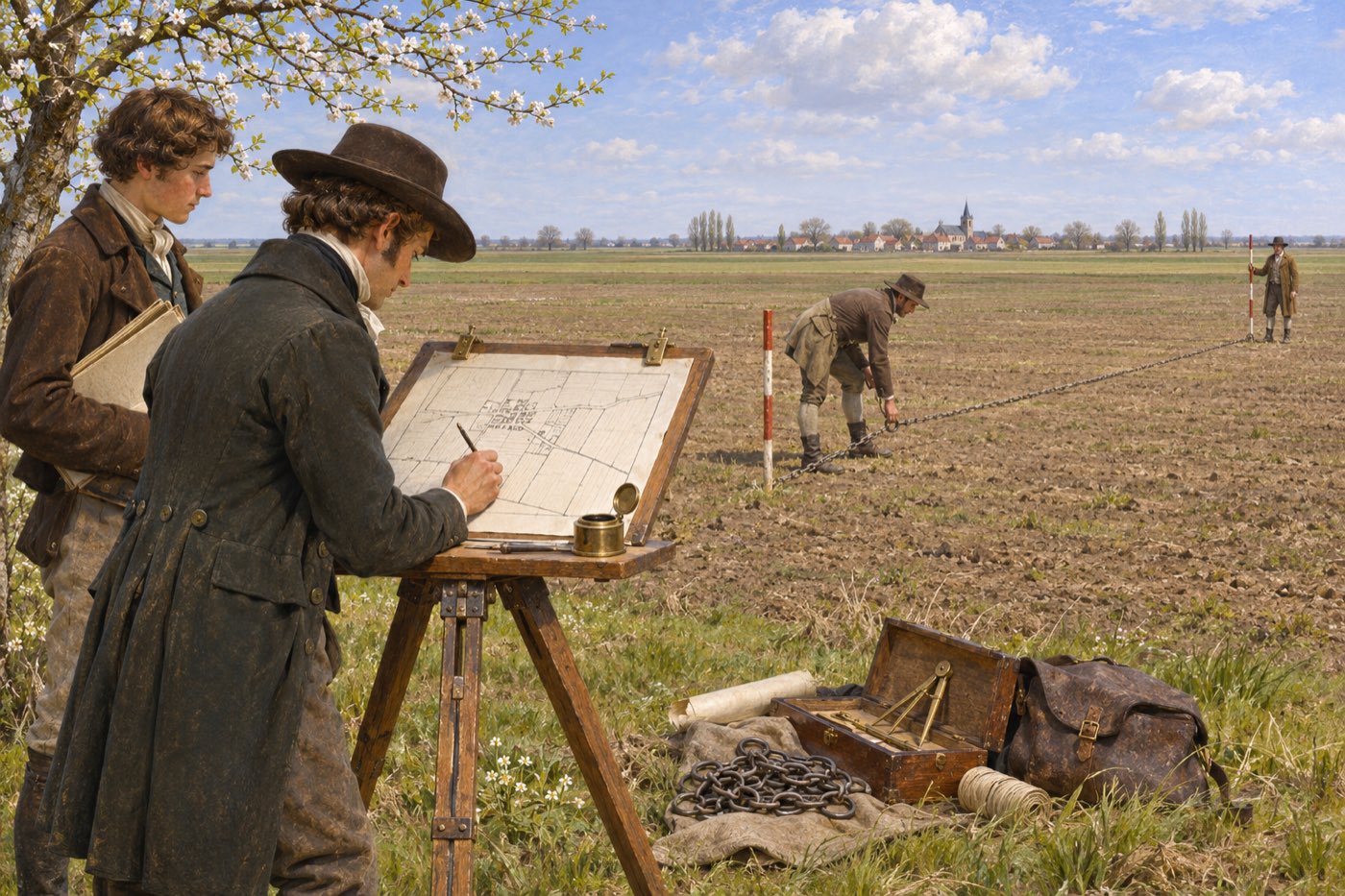
Surveyors measuring plots for the land register. Imagined illustration, not from the period. 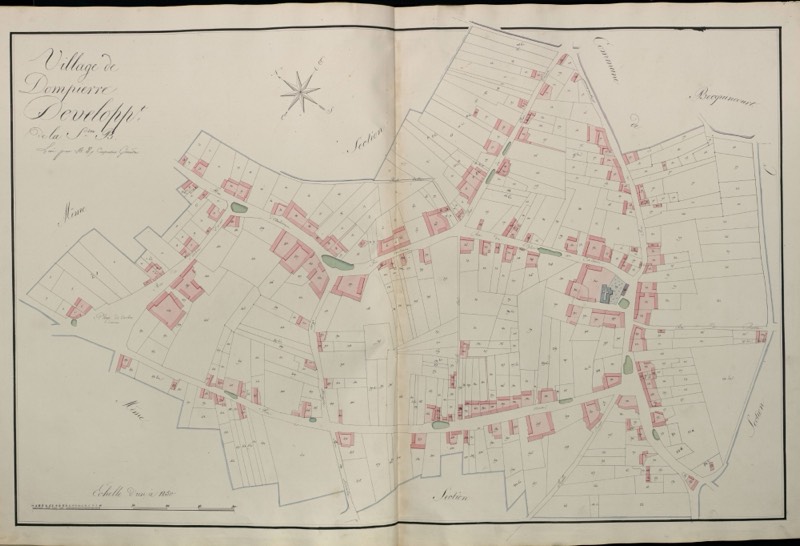
Dompierre, the cadastral plan of the village (1:1250): houses in pink, ponds in green, the church and its graveyard centre-right. 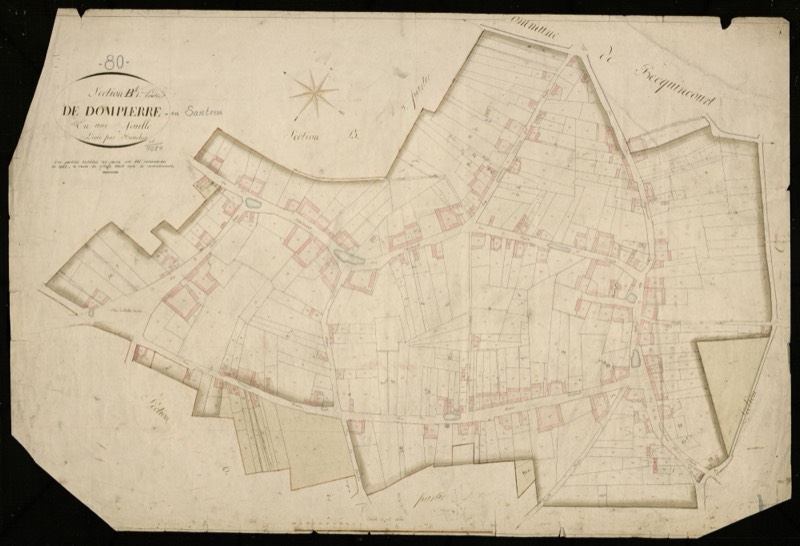
The same village on the revised plan: the areas tinted yellow were reorganised (“remembrées”) in 1922. 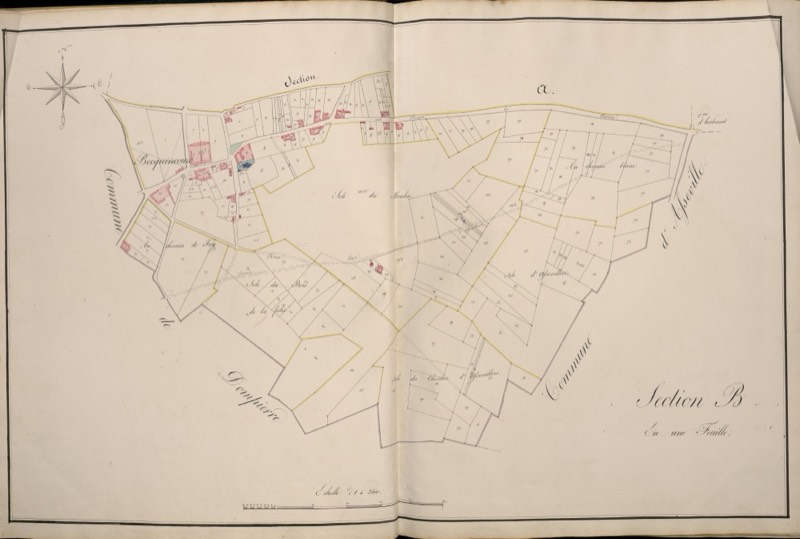
Becquincourt and its farmland on the cadastral plan (1:2500). 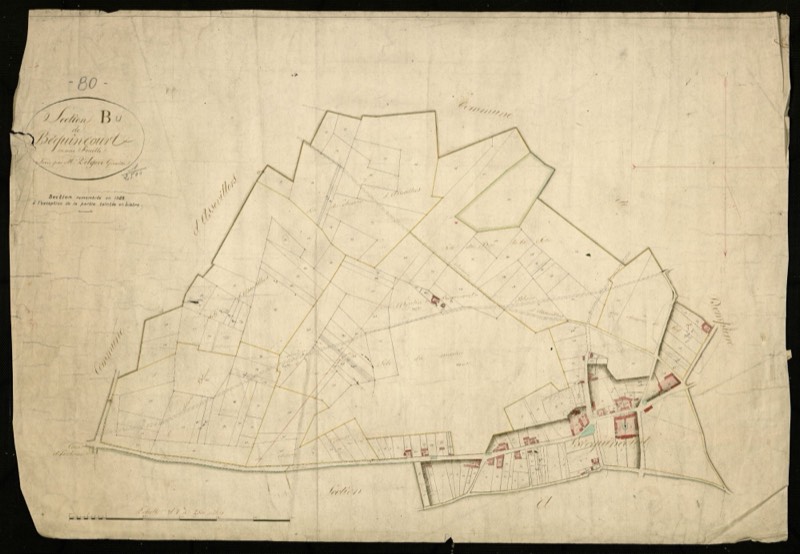
Becquincourt, section reorganised in 1923 “with the exception of the part tinted in bistre”. Source: Archives départementales de la Somme, plans of the so-called “Napoleonic” cadastre of Dompierre-en-Santerre and Becquincourt.
-
Around 1805
The windmills, away from the village
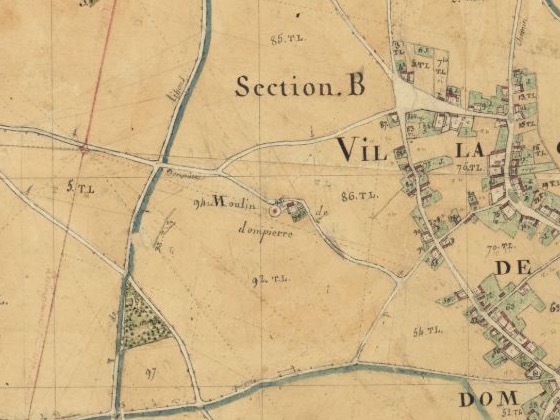
On the plans of Year XIII, every village has its mill, drawn as a small red circle with a few buildings beside it. At Dompierre, plot 94 bears the words "Moulin de Dompierre", west of the village, clear of the houses. At Becquincourt, the circle lies in section B, on the Assevillers road, also set apart. A windmill needs wind, so it was built away from the roofs, on open ground. The name of the Moulin farm at Becquincourt keeps its memory.
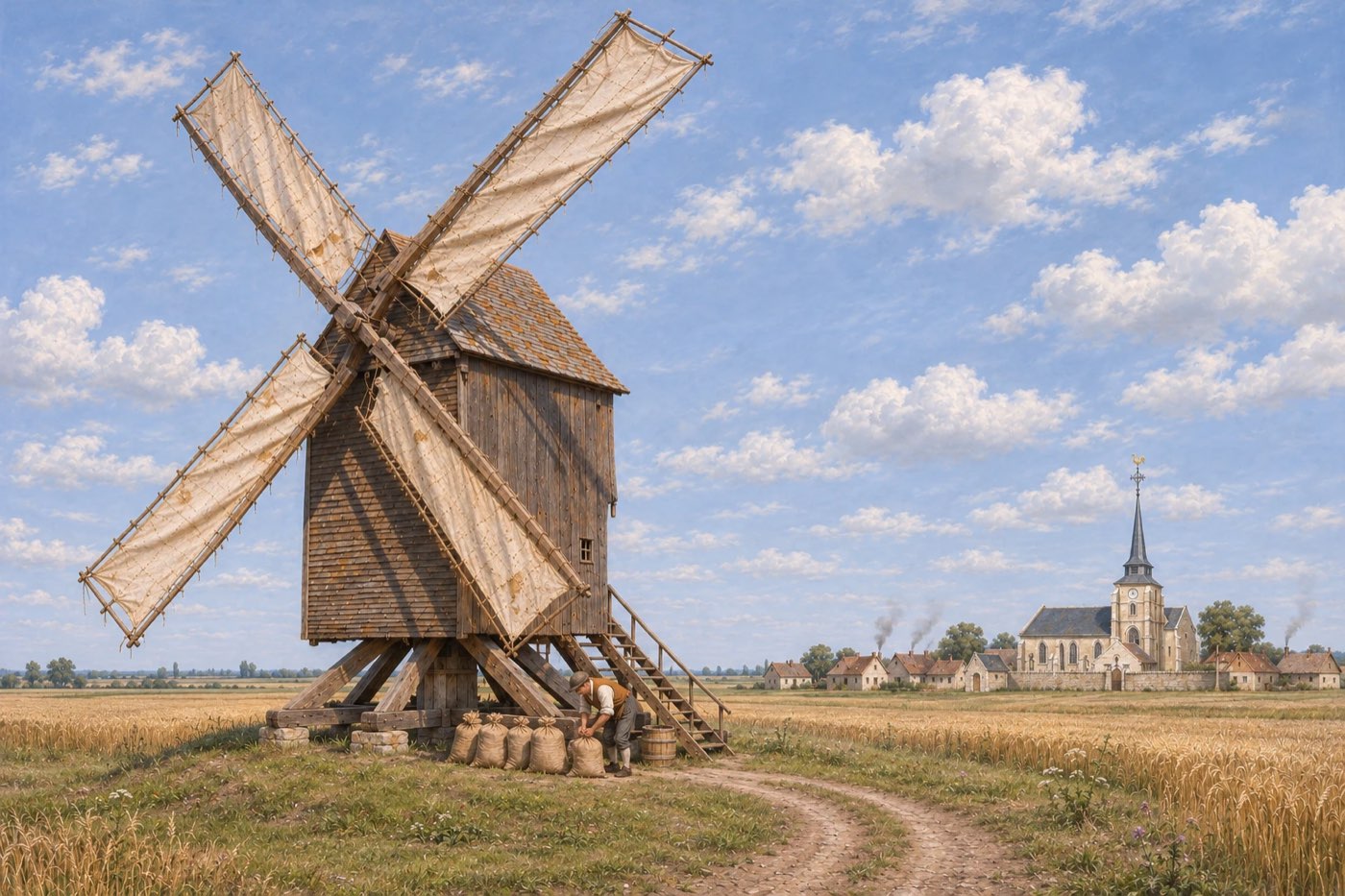
A wooden windmill in Picardy, as we can imagine it around 1800. Imagined illustration, not from the period. A circle on a plan does not tell us how the mill was built. In the Somme there are mostly two types. The post mill, entirely of wood: the whole body turns on a great central post, and the miller pushes it round with a long beam to face the sails into the wind. The tower mill, of stone or brick: only the cap turns. Both are old in the region: the post mill of Saint-Maxent dates from the 14th century, and the tower of Warloy-Baillon from the 15th. The one at Pozières, a 16th-century tower, was destroyed in 1916 during the Battle of the Somme; the one at Ochancourt, a wooden post mill, was blown down by a storm in 1917.
Under the Ancien Régime, peasants were in principle obliged to have their grain ground at the lord's mill and to pay him a fee: this was the "banalité". We have found no document saying when the mills of Dompierre and Becquincourt were built, or what type they were. If you know more, write to us: it will be a fine page to complete.
- 1814 – 1815
Cossacks in the village
After Napoleon's fall, Cossacks of the Russian army stay in the commune during the Campaign of France, and again after the Hundred Days.
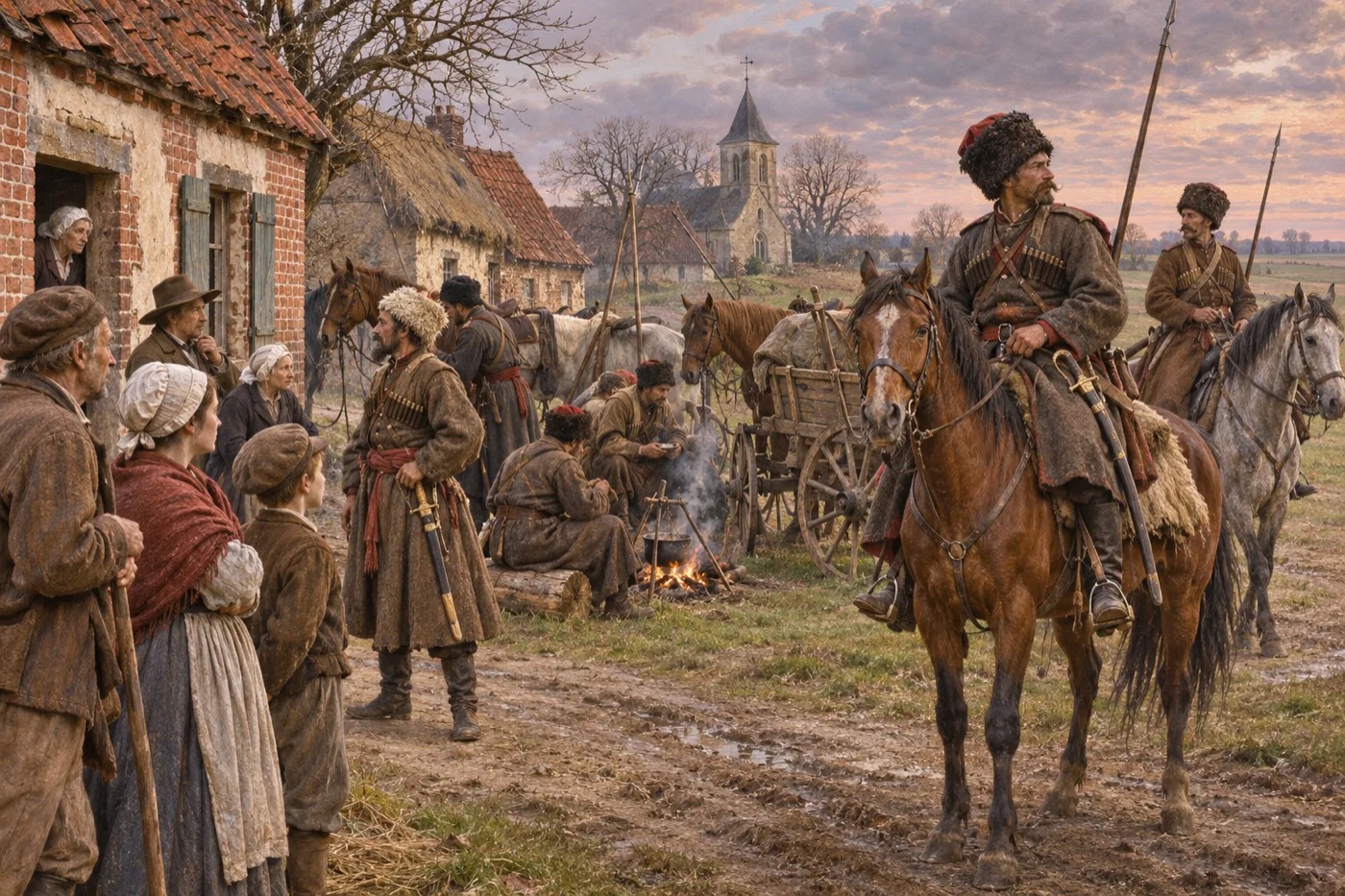
Cossacks in the village, 1814. Imaginary illustration, not from the period. - Winter 1870–1871
The Prussian invasion
During the siege of Péronne, General von Goeben lodges at the Ferme du Moulin in Becquincourt on 6 January 1871, and for ten days at the priest's house in Dompierre, from where he issues his orders. The requisitions cost the inhabitants 74,259 francs.
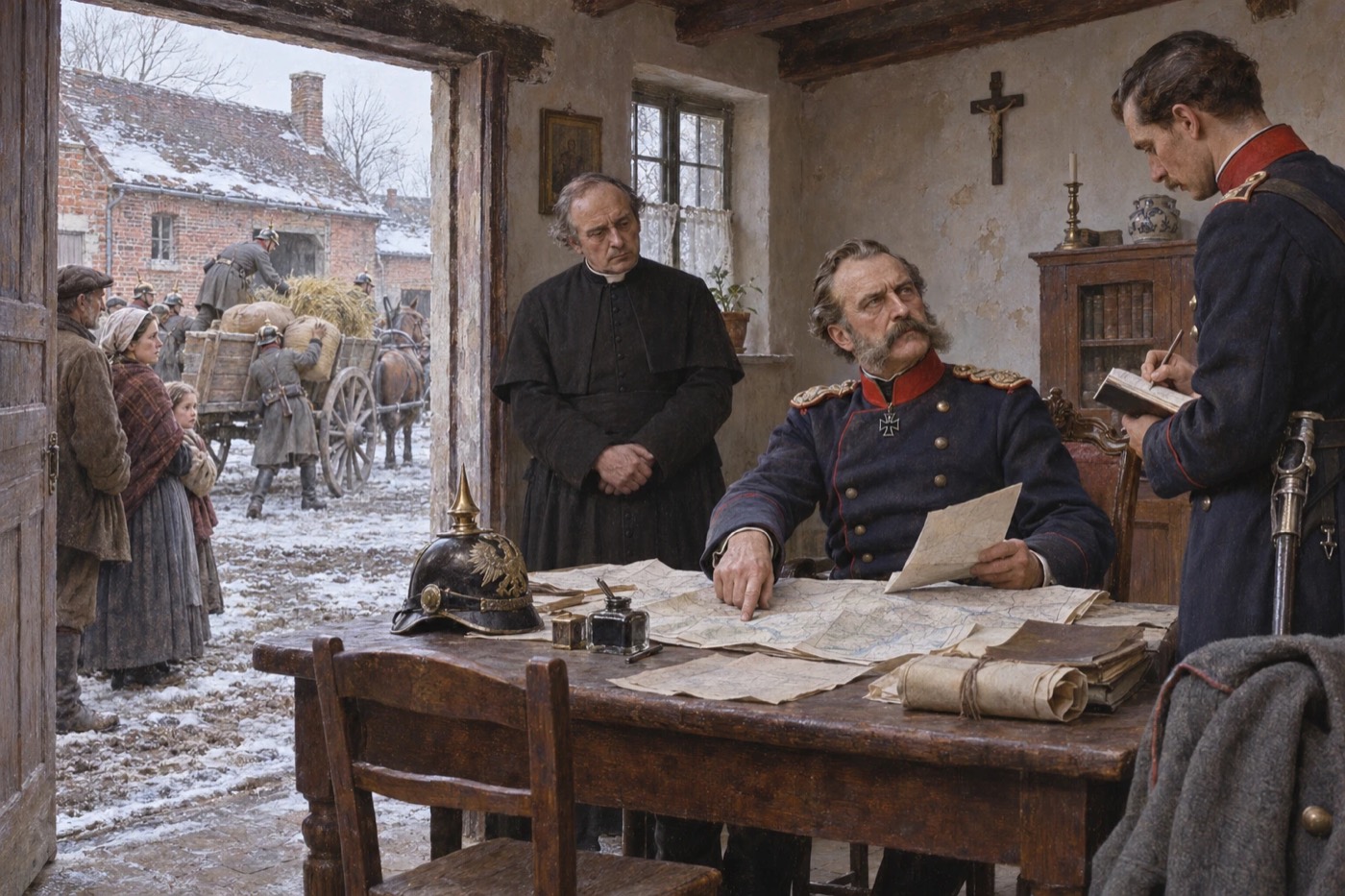
A Prussian staff at the priest's house, winter 1871. Imaginary illustration, not from the period. -
27 September 1877
The two churches, drawn from life
On the same day, the painter Oswald Macqueron, author of many watercolours of churches in the Somme, sketches on the spot the church of Dompierre and that of Becquincourt. In Dompierre, the clock tower carries a tall slate spire, with the nave's pointed-arch windows, the cemetery wall and its iron crosses. In Becquincourt, a more modest slate bell tower rises over the nave and the chancel, behind the boundary wall, under the eye of three walkers. Both medieval churches would be destroyed in the Great War.
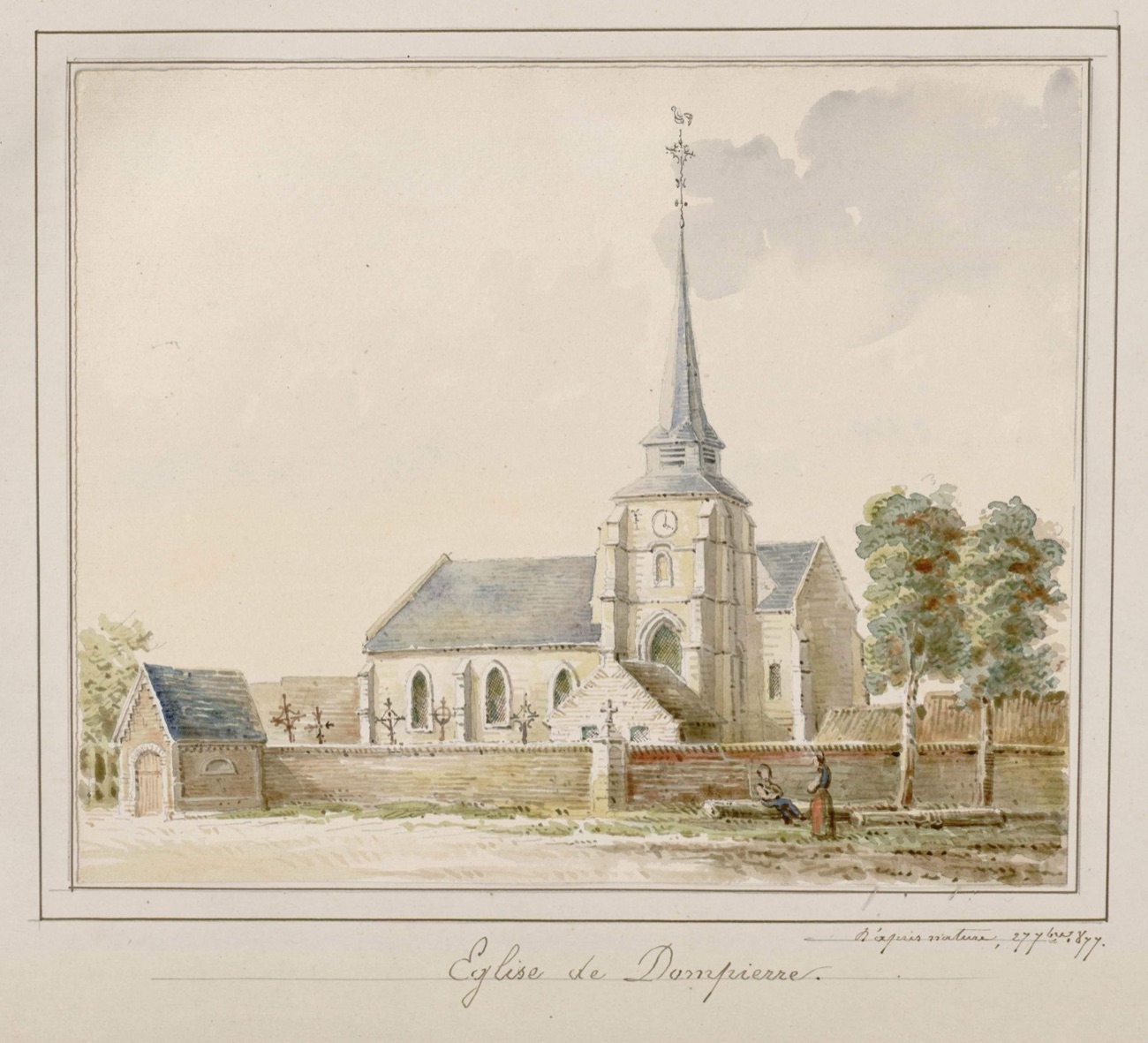
Church of Dompierre. Watercolour by Oswald Macqueron (1822-1899), "drawn from life", 27 September 1877. Source: Abbeville Patrimoine. Public-domain work. 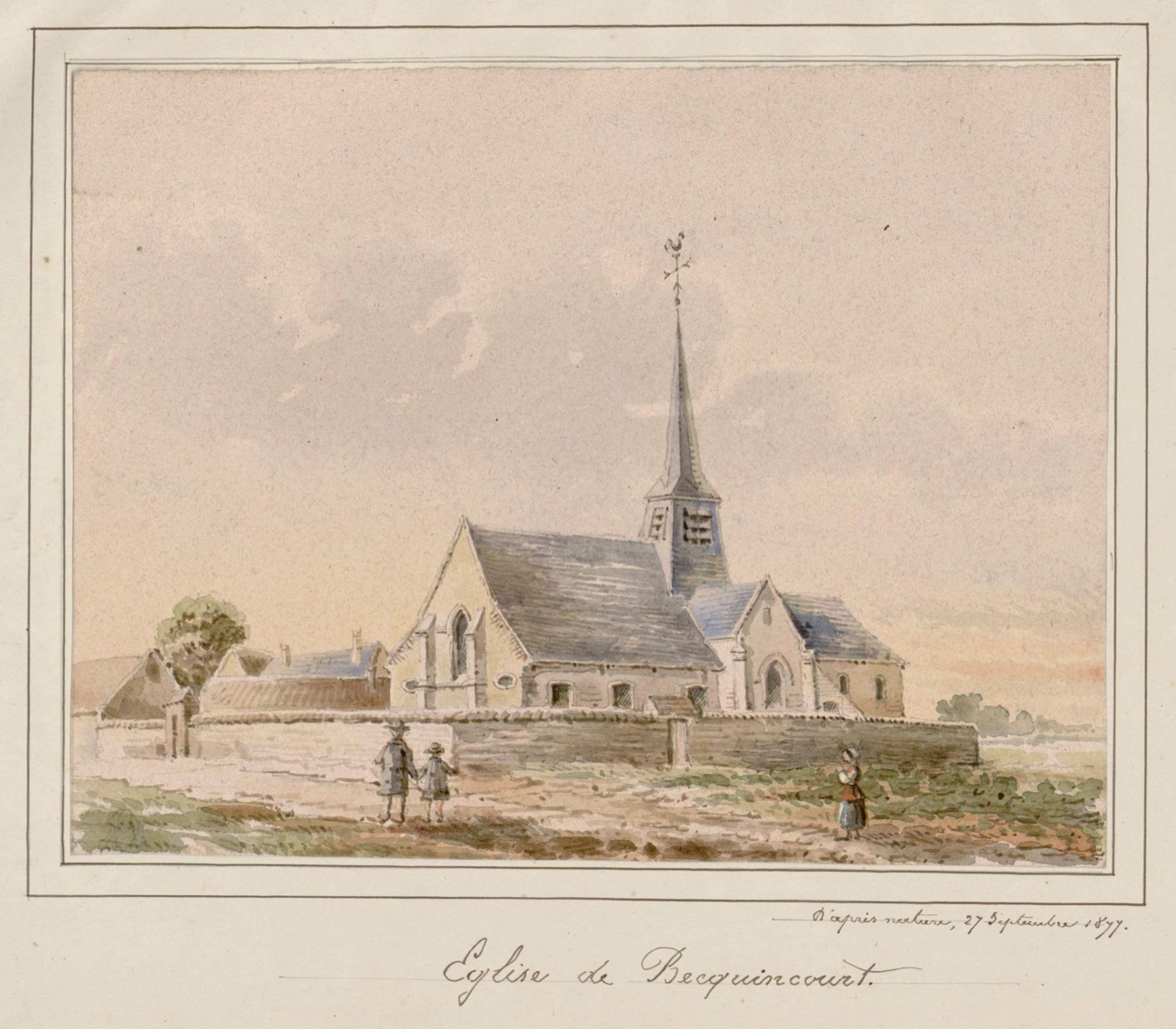
Church of Becquincourt. Watercolour by Oswald Macqueron (1822-1899), "drawn from life", 27 September 1877. Public-domain work. - 1879
The birth of the sugar mill
The firm Normand et Cie founds a beet sugar mill at the edge of the village. It will transform local life for more than a century. Read its history.
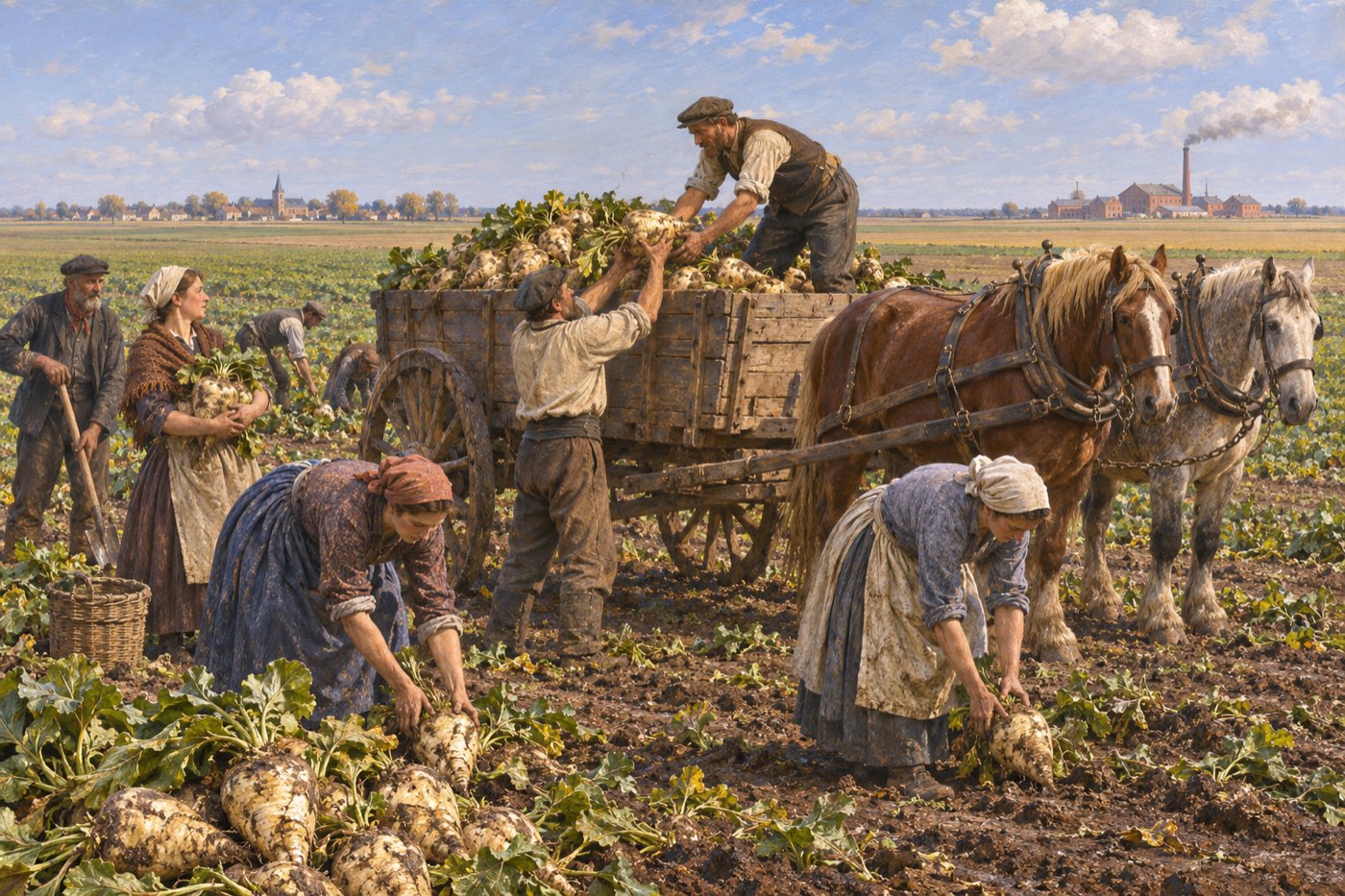
Sugar beet harvest, around 1879. Imagined illustration, not from the period. - 1896
The village on the eve of a new century
At the census, the commune of Dompierre has 625 inhabitants: 601 in the village, 5 at the Bussu farm and 19 at "La Fabrique", the sugar mill hamlet. Becquincourt has 153.
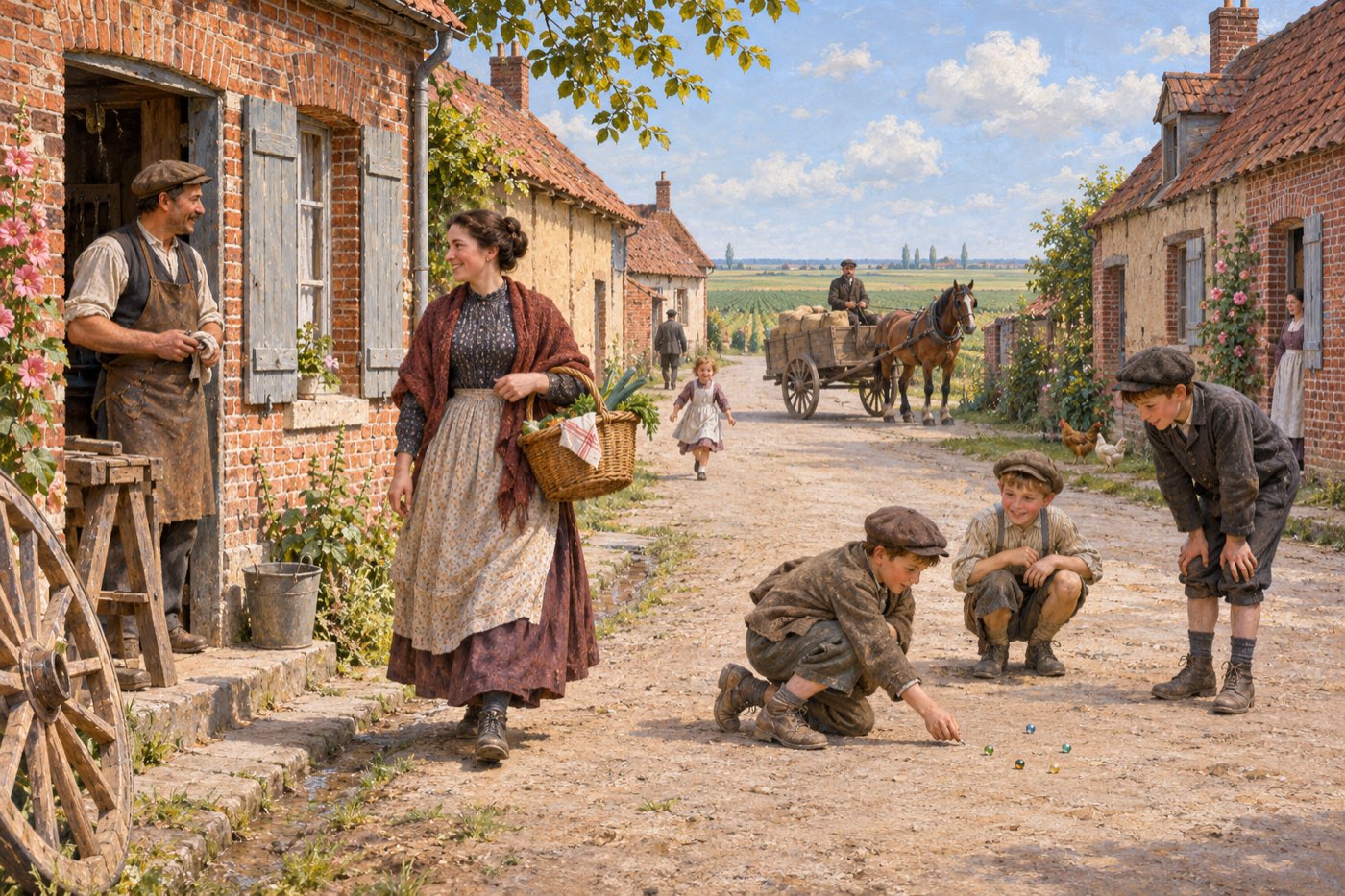
Life in the village, around 1896. Imagined illustration, not from the period. - 1899
The schoolteachers take up their pens
Mr Deneux in Dompierre and Mr Cacheleux in Becquincourt each write the geographical and historical report on their commune. Dompierre then has its sugar mill, a cheese dairy, two whip factories and three schools; Becquincourt, 153 inhabitants, a brickworks and a 15th-century church. Both ask for a railway. Read the two reports.
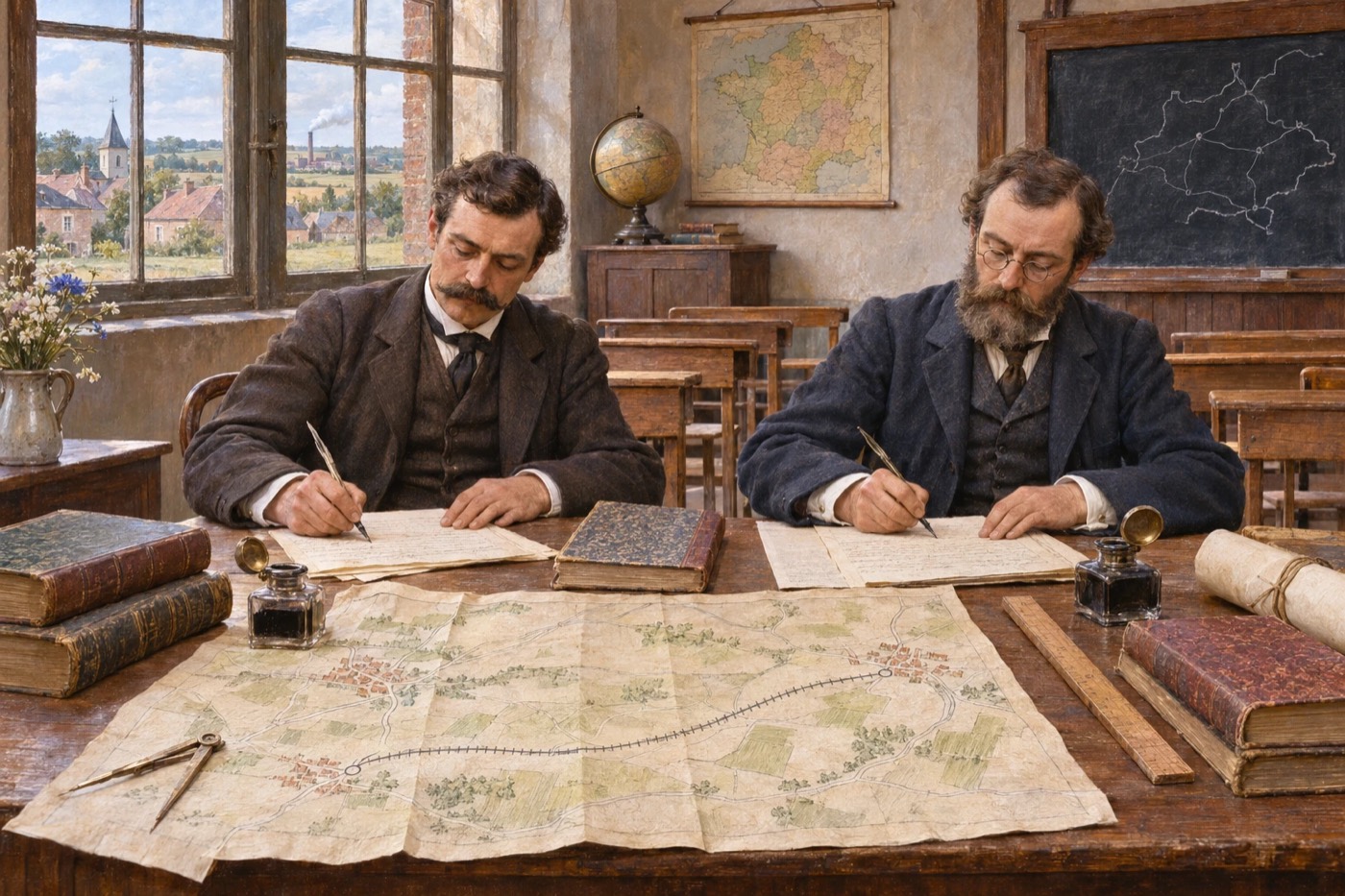
Two schoolmasters write their report, 1899. Imaginary illustration, not from the period.
The Great War
1914 – 1918For nearly two years, the front line runs right through here. Dompierre and Becquincourt will emerge from it annihilated, and decorated with the Croix de guerre.
- Late August 1914
The invasion
Canonnade, fires, inhabitants fleeing: the uhlans ride into the village. On 28 August it is looted. The uhlans are light cavalry armed with a lance, a sabre and firearms, the equivalent of lancers in the Slavic and Germanic armies.
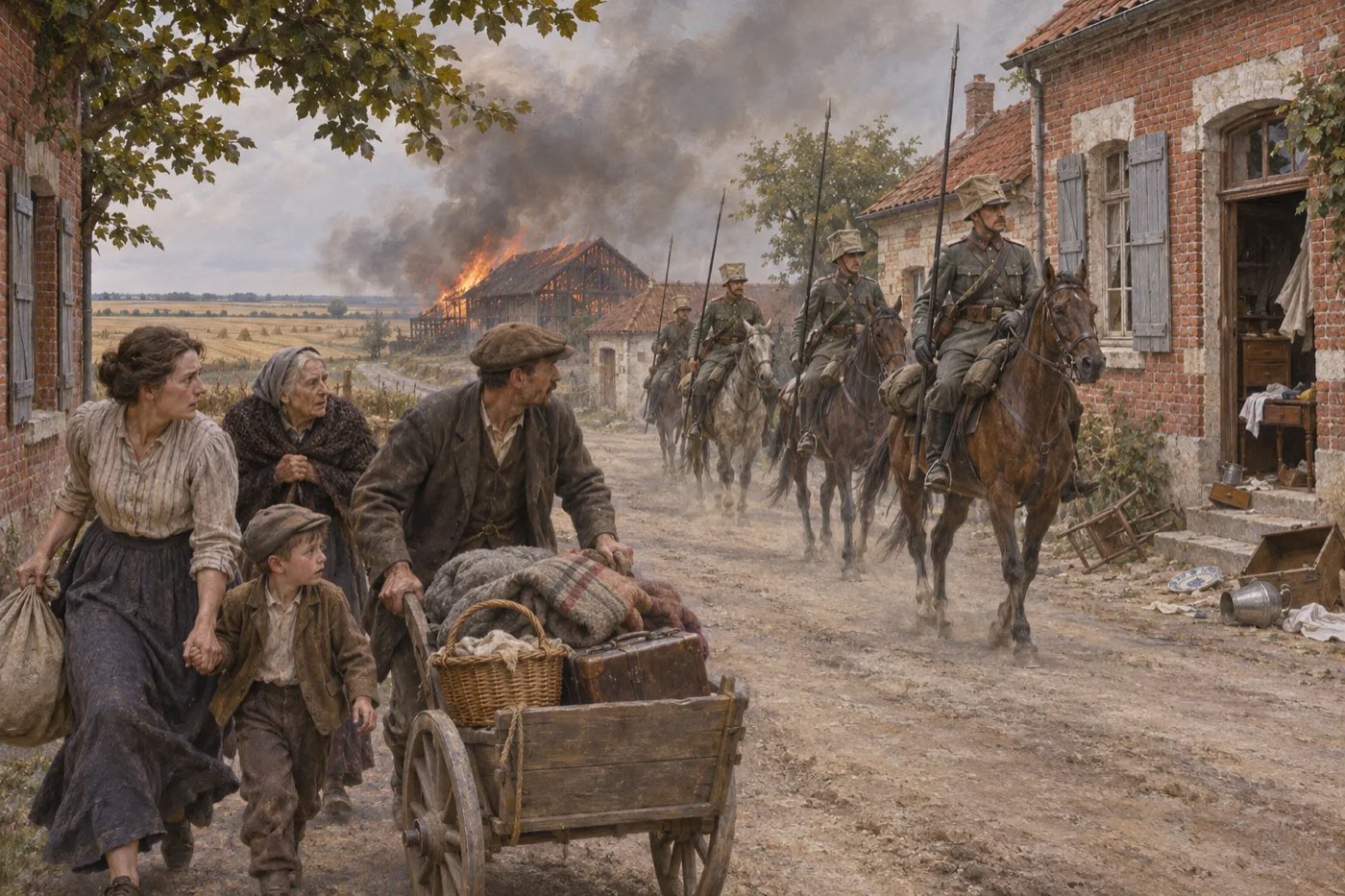
Late August 1914: villagers fleeing the uhlans. Imagined illustration, not from the period. - September 1914
Caught between two fires
The French return on 14 September, after the victory of the Marne. At the end of the month, eighteen German guns shell the village for five days; eighty able-bodied men are taken to Péronne and then to Germany.
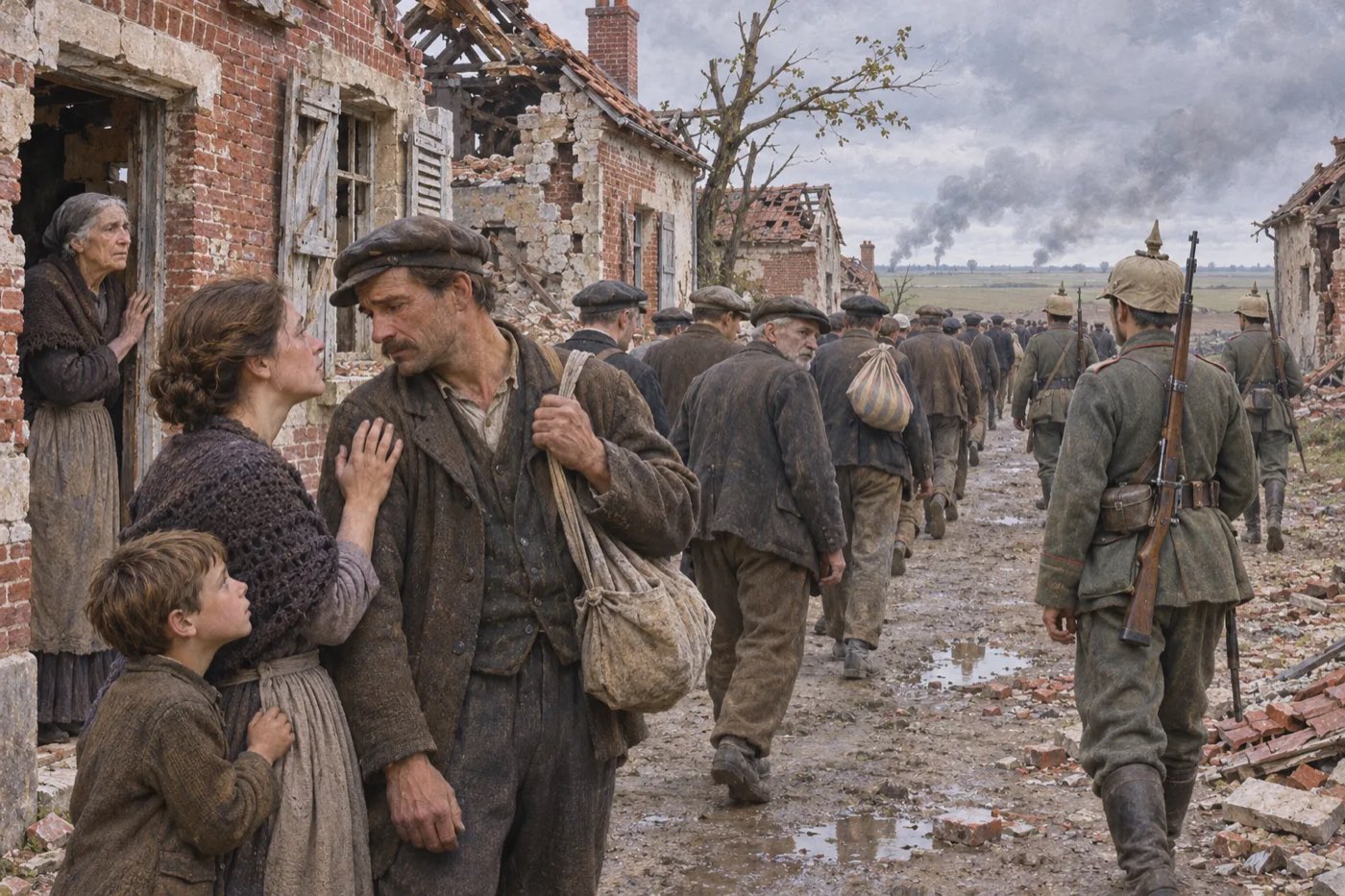
Men of the village led away by the German army, September 1914. Imagined illustration, not from the period. - 30–31 October 1914
The first German line
After fierce fighting, the two villages find themselves on the German side of the front. The sugar mill, already in ruins, becomes a fortified strongpoint.
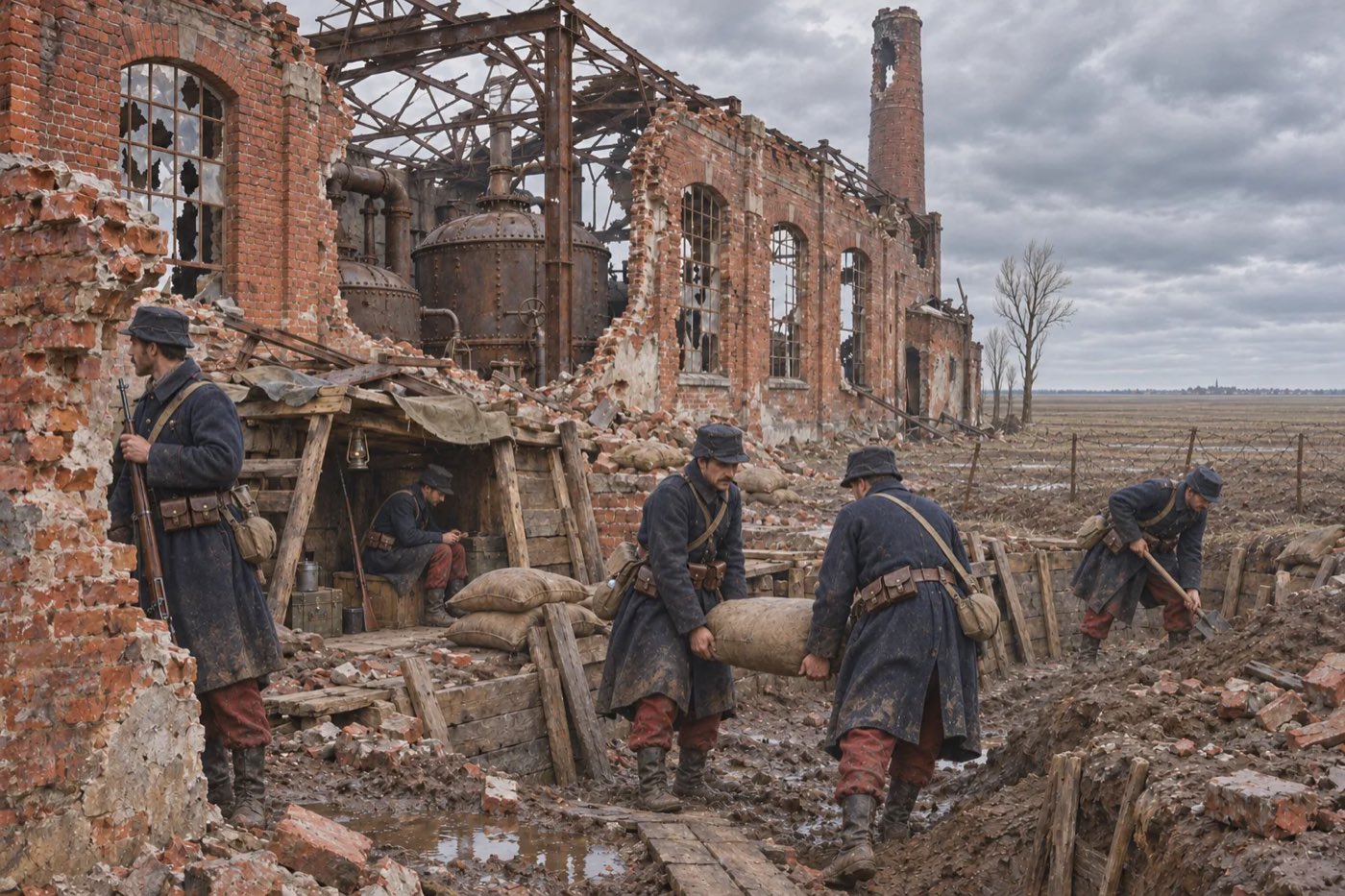
The ruined sugar factory fortified by French soldiers, late October 1914. Imagined illustration, not from the period. - Christmas 1914
Fraternisation at the sugar mill
On Christmas night, then on 30 December, fraternisation between enemy soldiers is reported in the ruins of the factory.
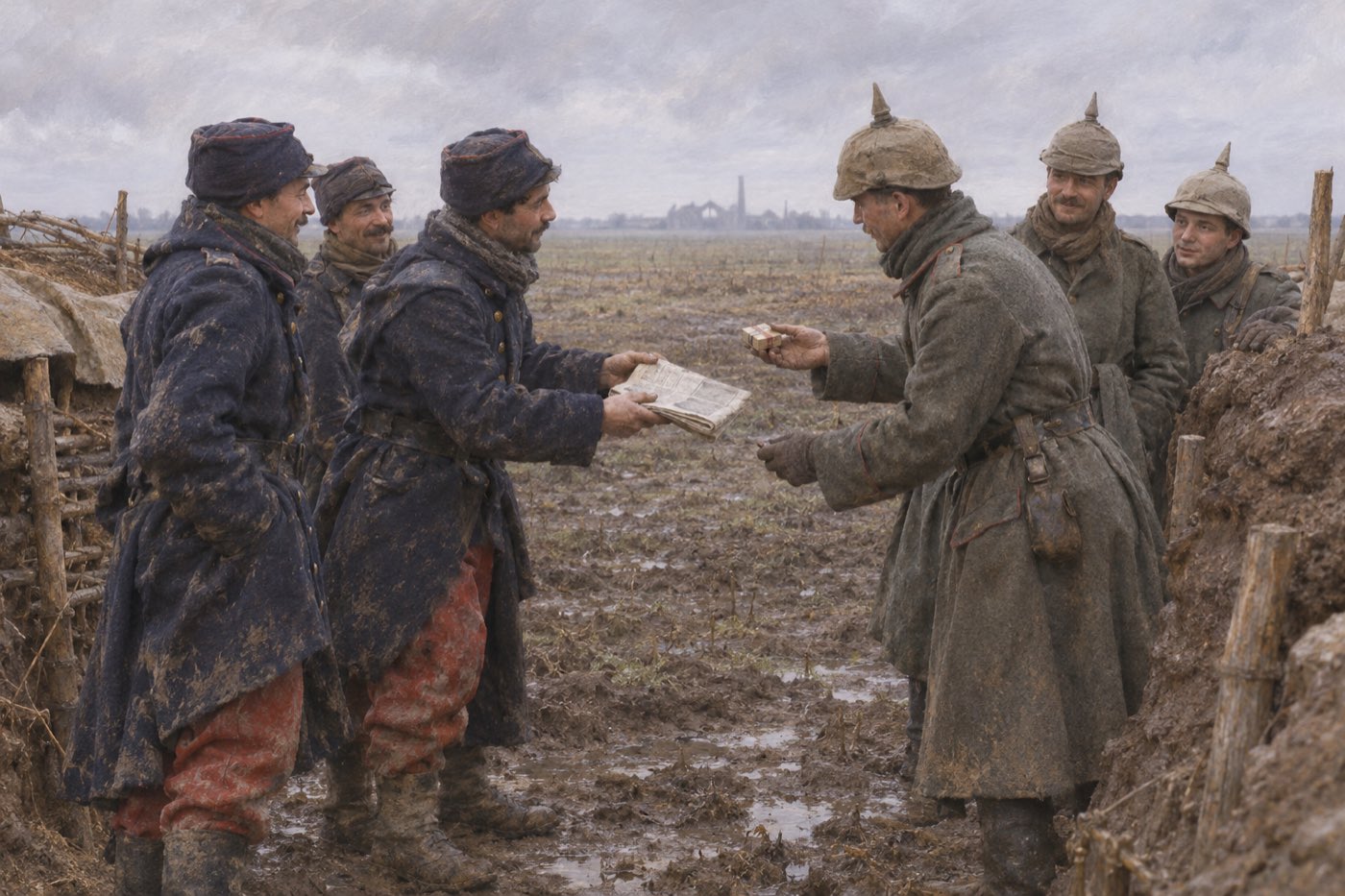
Newspapers and cigarettes exchanged between the lines, December 1914. Imagined illustration, not from the period. - 1915
The war of the mines… and Blaise Cendrars
In spring and summer, men fight underground, with tunnels and explosives. The writer Blaise Cendrars, a volunteer in the Foreign Legion, is among those fighting; he will remember it in La Main coupée.

Anonymous sappers in a gallery: the underground war, 1915. Imagined illustration, not from the period. 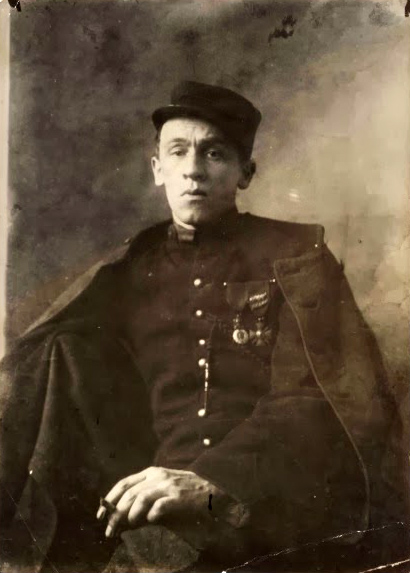
Blaise Cendrars in uniform.Period photograph, source: Wikipedia - 1 July 1916
First day of the Battle of the Somme
Dompierre is retaken the same day by the 23rd Colonial Infantry Regiment. To supply the offensive, the Allied armies lay a network of narrow-gauge railways: the ancestor of the little steam train.
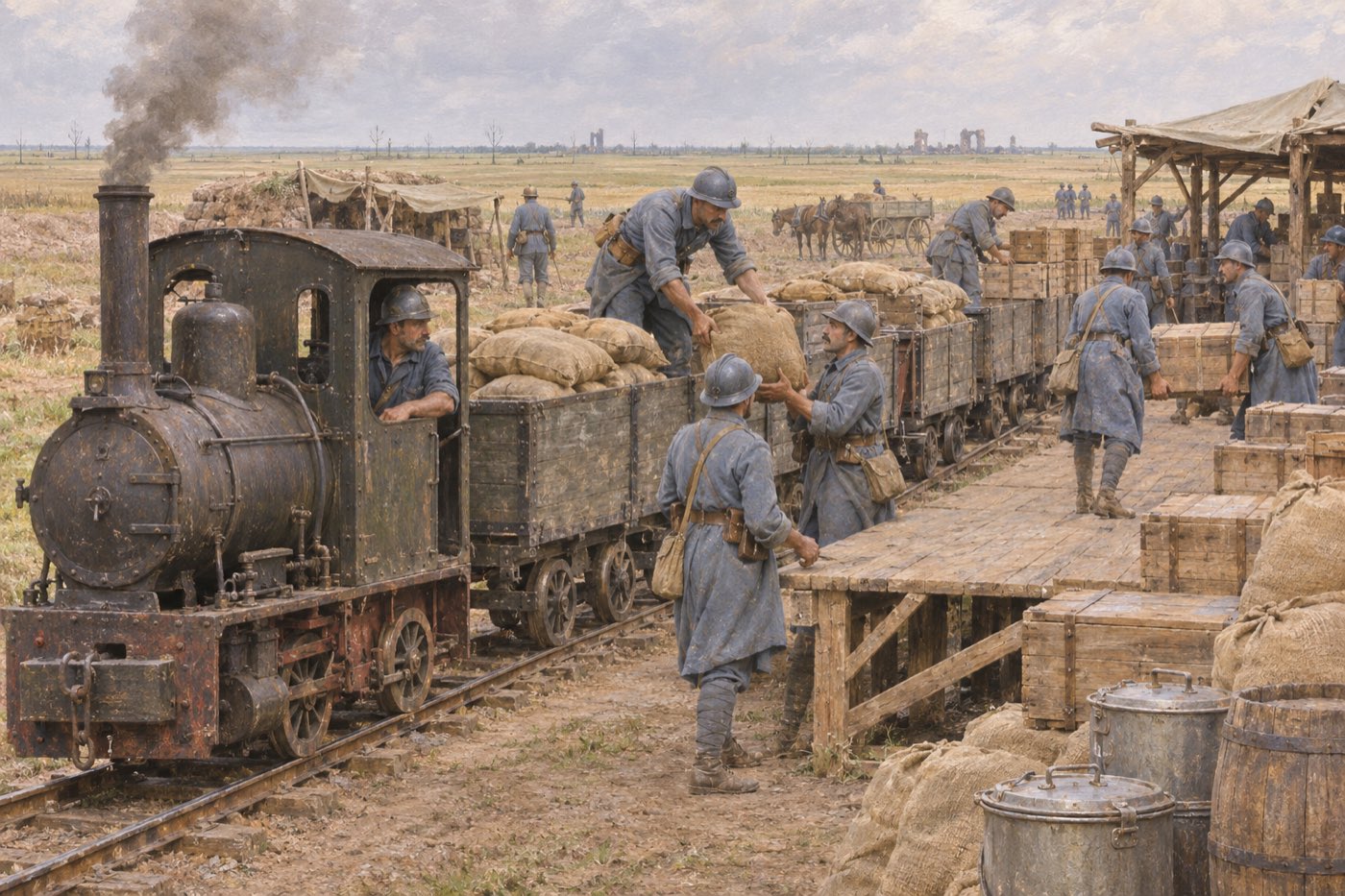
Narrow-gauge supply during the 1916 offensive. Imagined illustration, not from the period. - 5 August 1916
The sugar factory in L'Illustration
The 5 August 1916 issue devotes a page to “The Somme offensive: the Dompierre sugar factory”. Quoting a correspondent of Le Petit Parisien, the paper says it was “not knocked down, but shredded by gunfire”, and describes a large crucifix, its left arm torn off by a shell, still standing amid the ruins. File of the Hauts-de-France heritage inventory.
- Late 1916
The mud
The painter Jean Hugo, great-grandson of Victor Hugo, will describe soldiers bogged down in the mud of Dompierre in autumn 1916. The painter François Flameng draws the ruins of the sugar mill for L'Illustration.
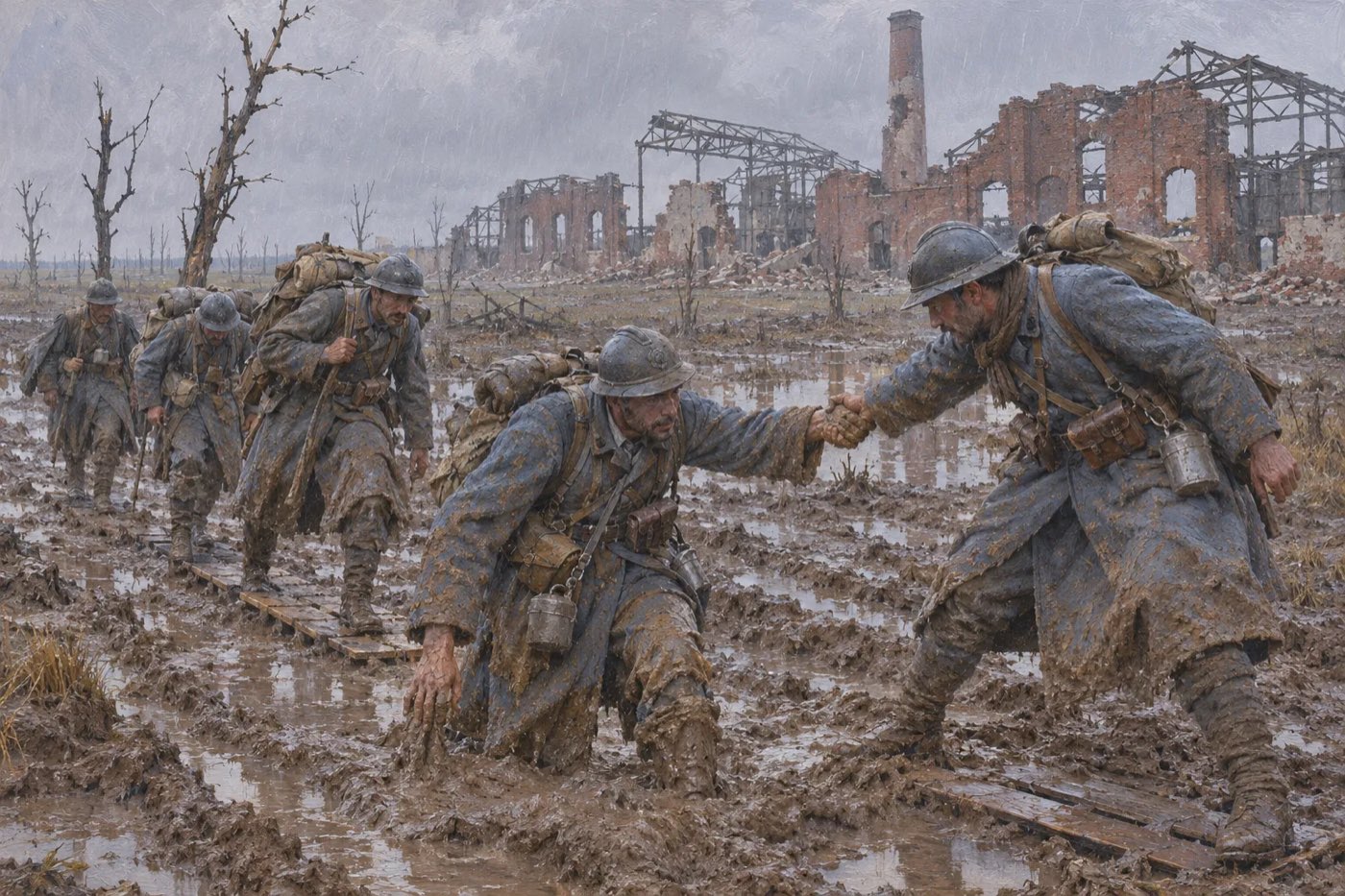
In the mud of Dompierre, autumn 1916. Imagined illustration, not from the period. - 1917 – 1918
British troops, then fighting returns
The British are stationed here from March 1917 to March 1918, when the German offensive surges towards Amiens. The village is finally liberated on 23 August 1918 by the British Fourth Army of General Rawlinson.
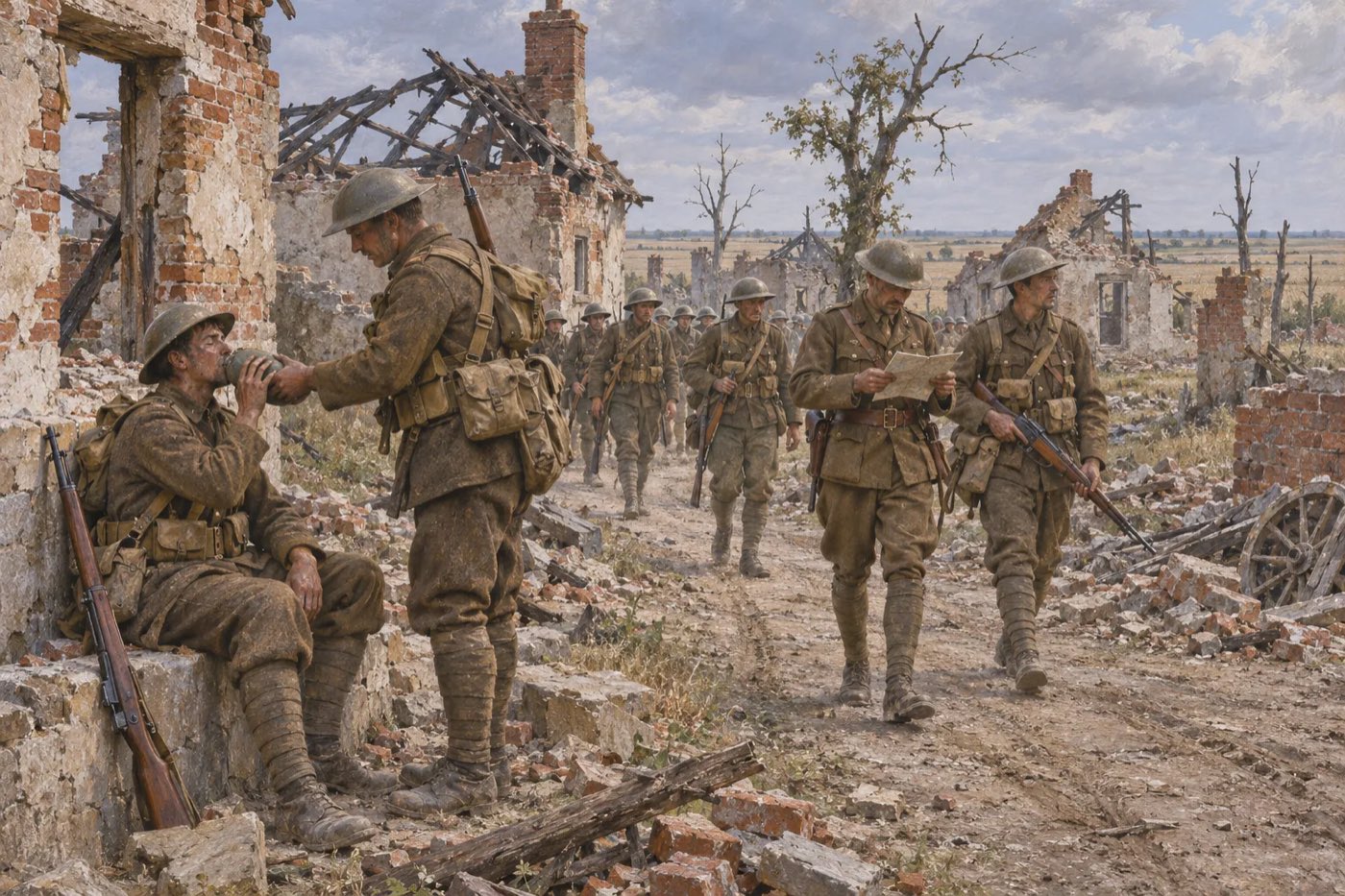
British soldiers passing through the ruined village, 1917–1918. Imagined illustration, not from the period. - 30 October 1920
The Croix de guerre
Both communes, declared destroyed, are cited and awarded the Croix de guerre 1914-1918.
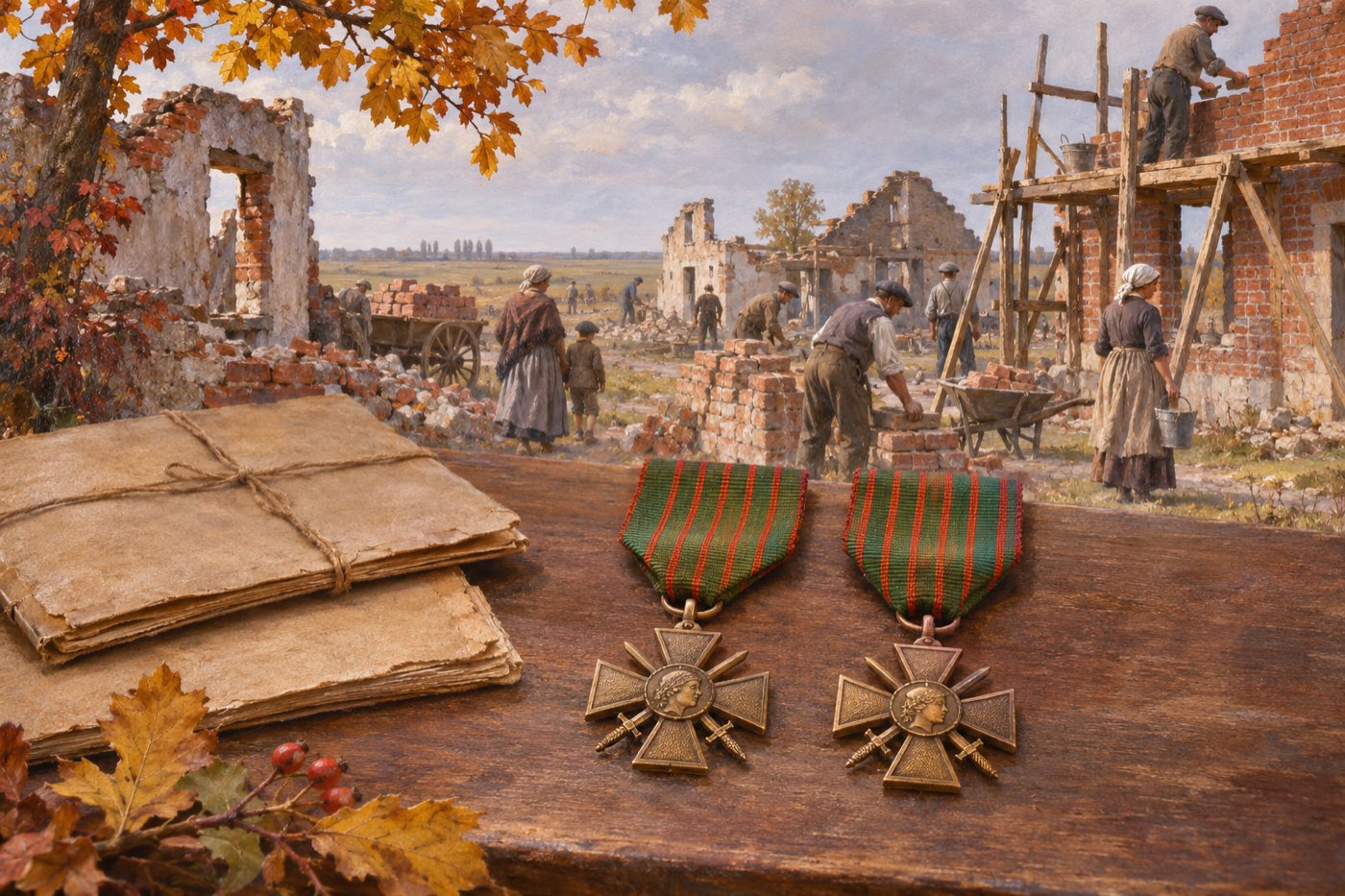
An evocation of the Croix de guerre and of the reconstruction, 1920. Imagined illustration, not from the period.
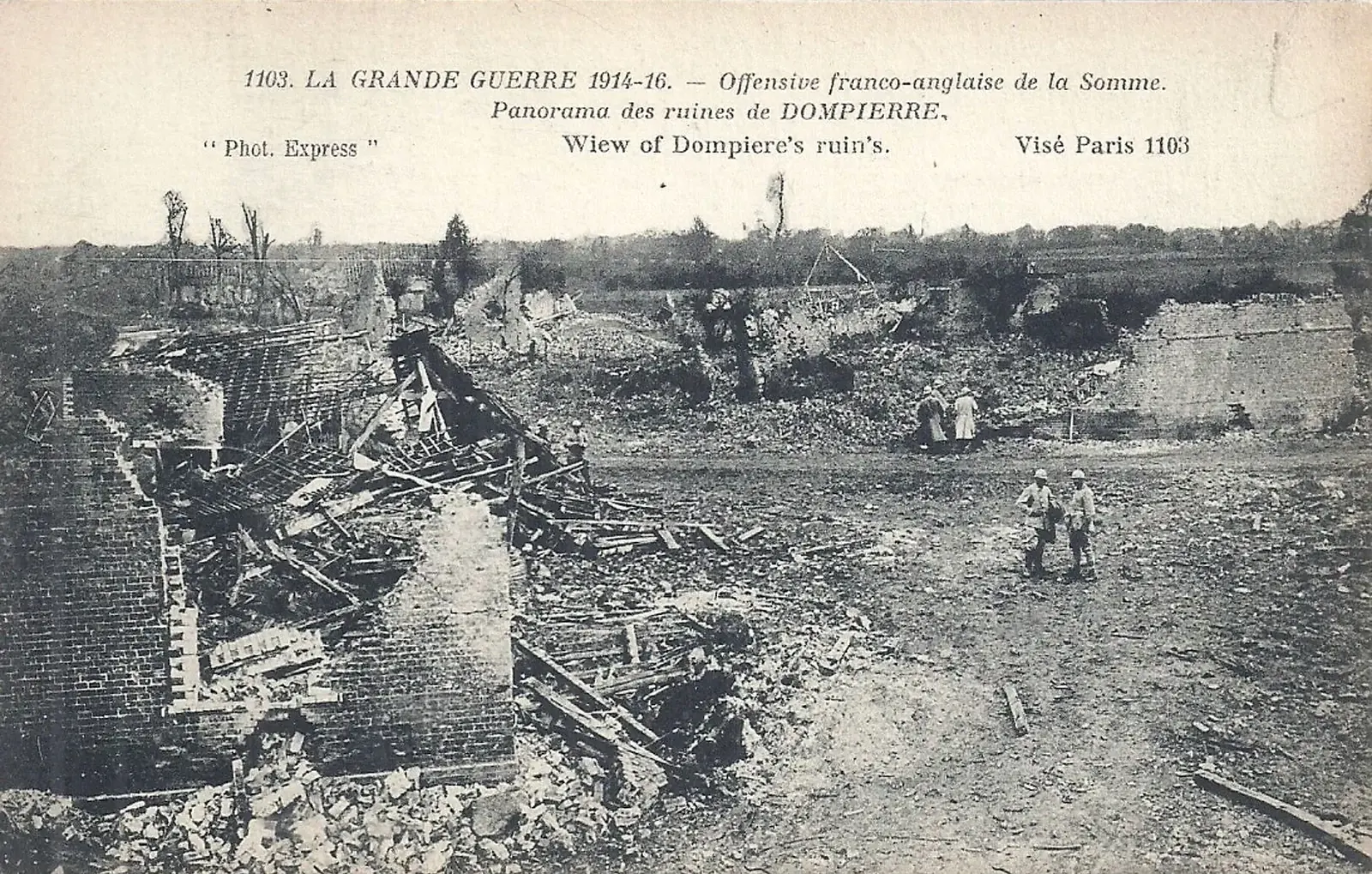
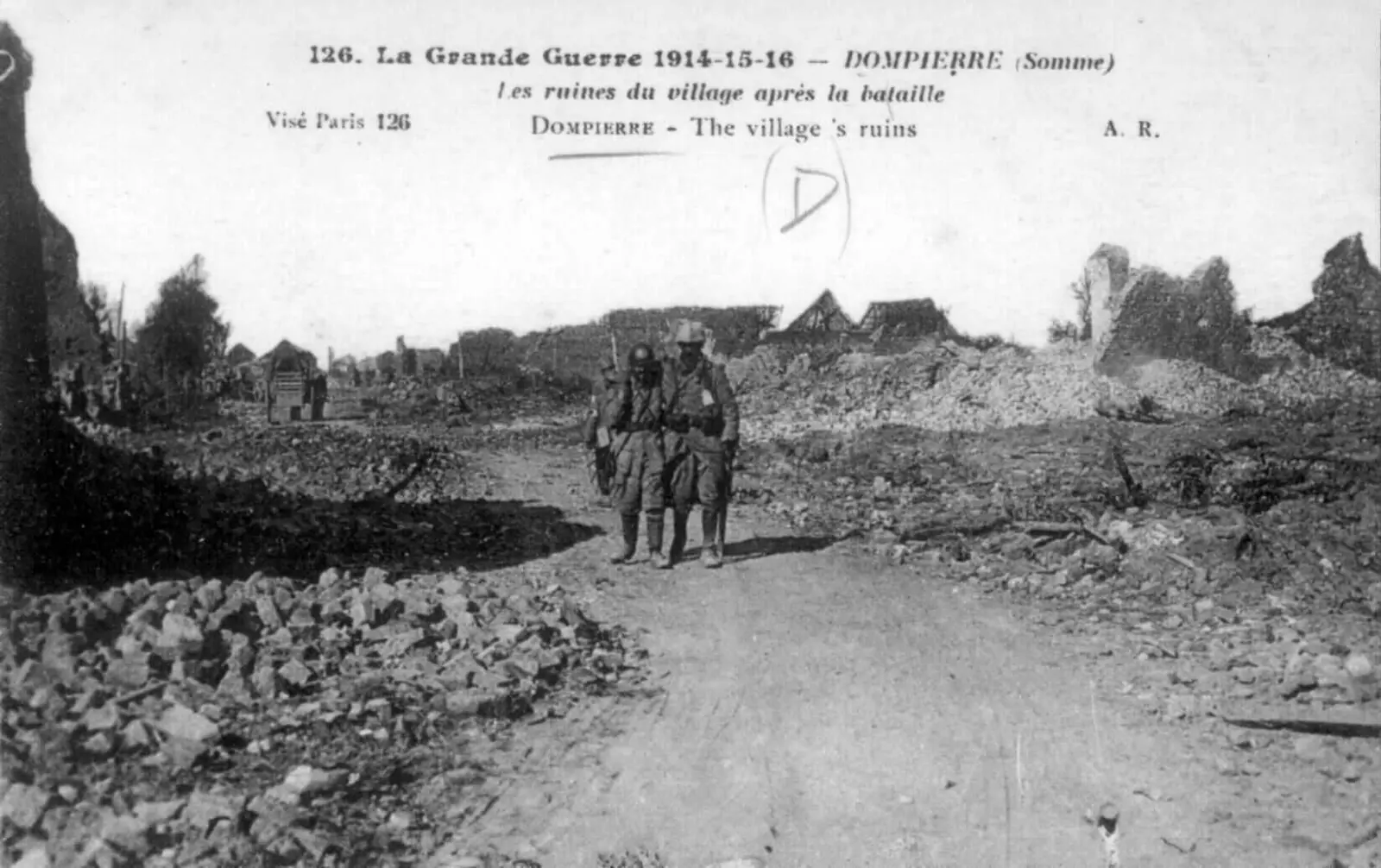
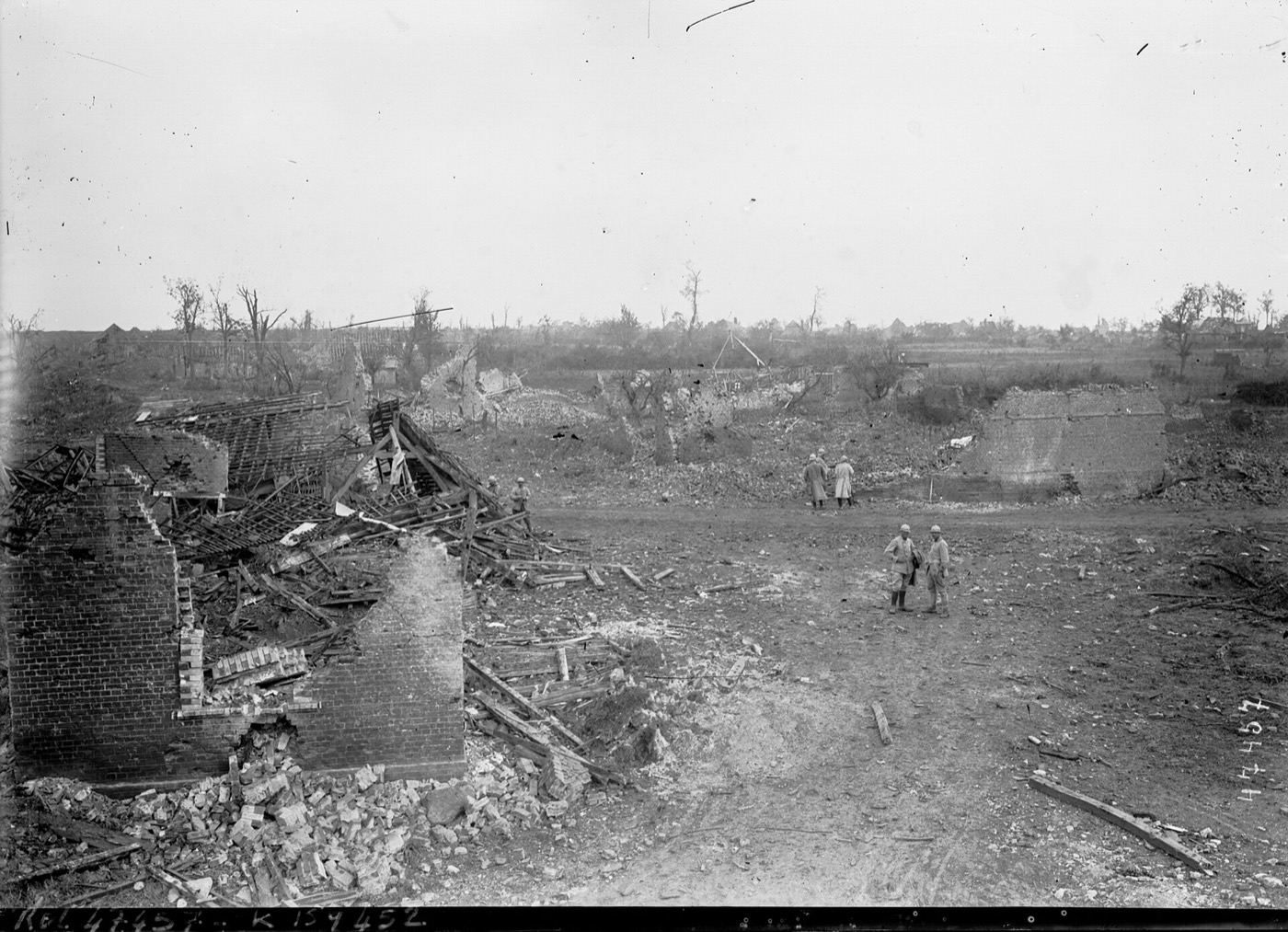

See all the Great War postcards →
The Reconstruction
1920 – 1939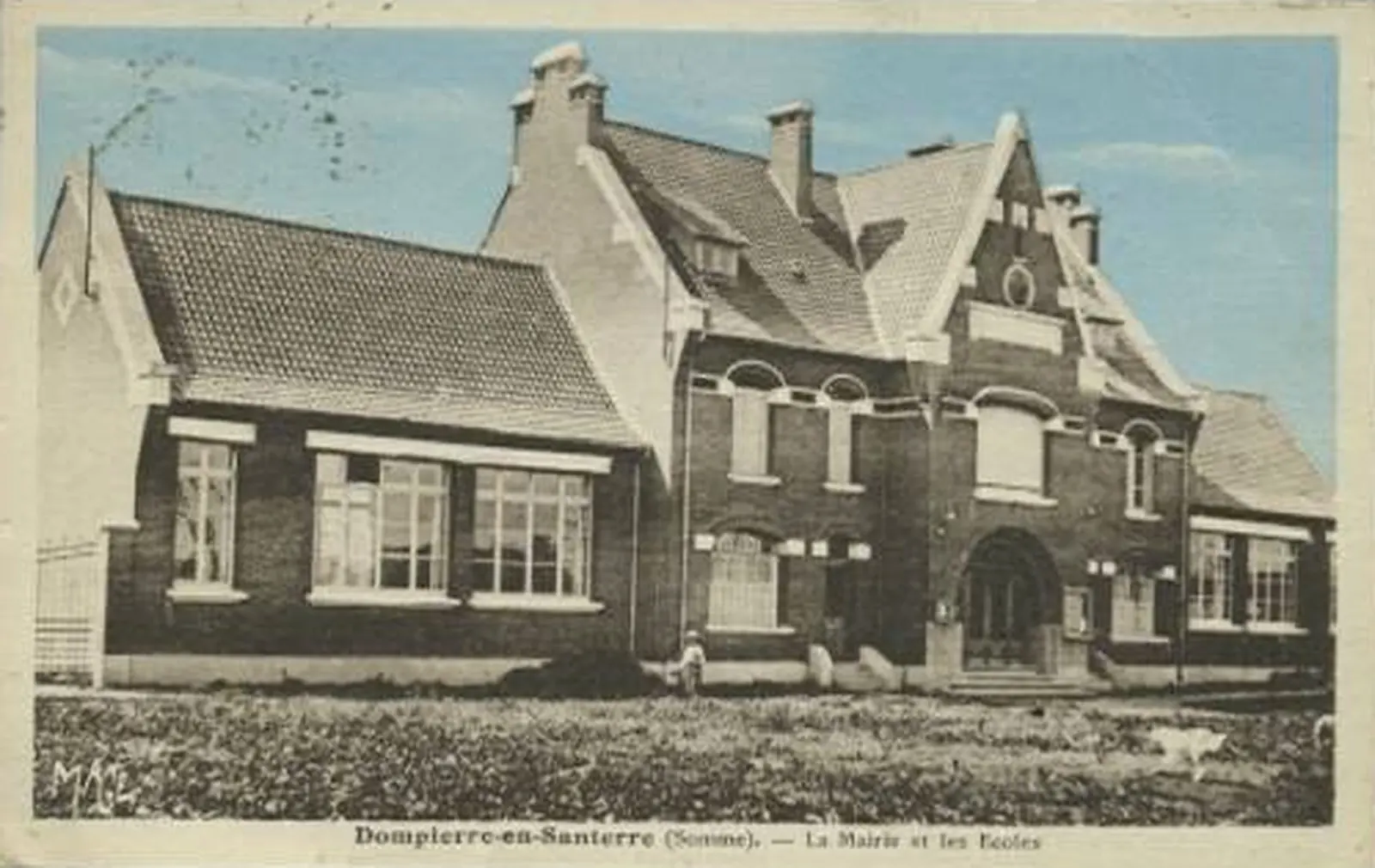
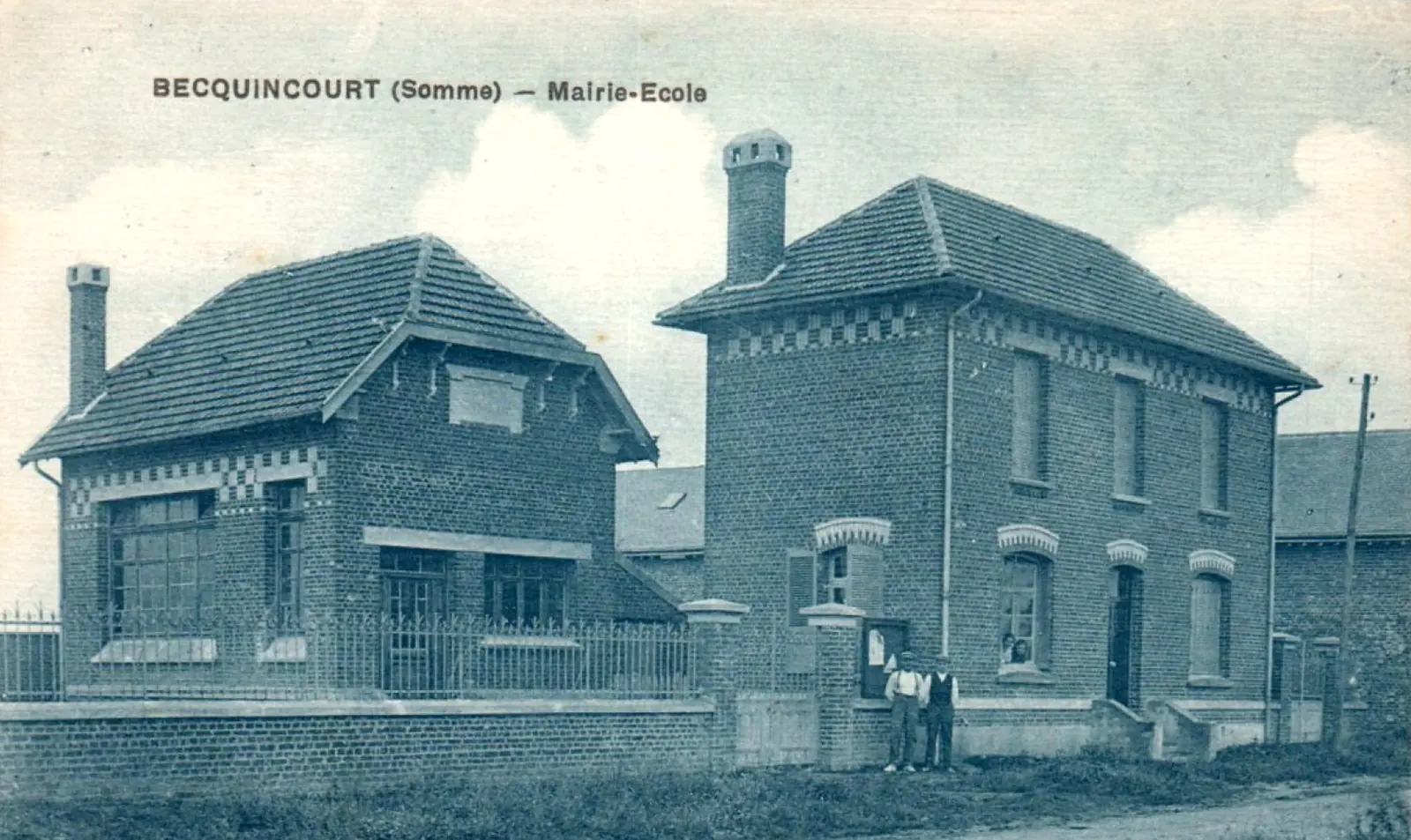
- 1920
We rebuild, and we remember
Reconstruction begins. Next to the communal cemetery, a military cemetery is created that will become the national cemetery.
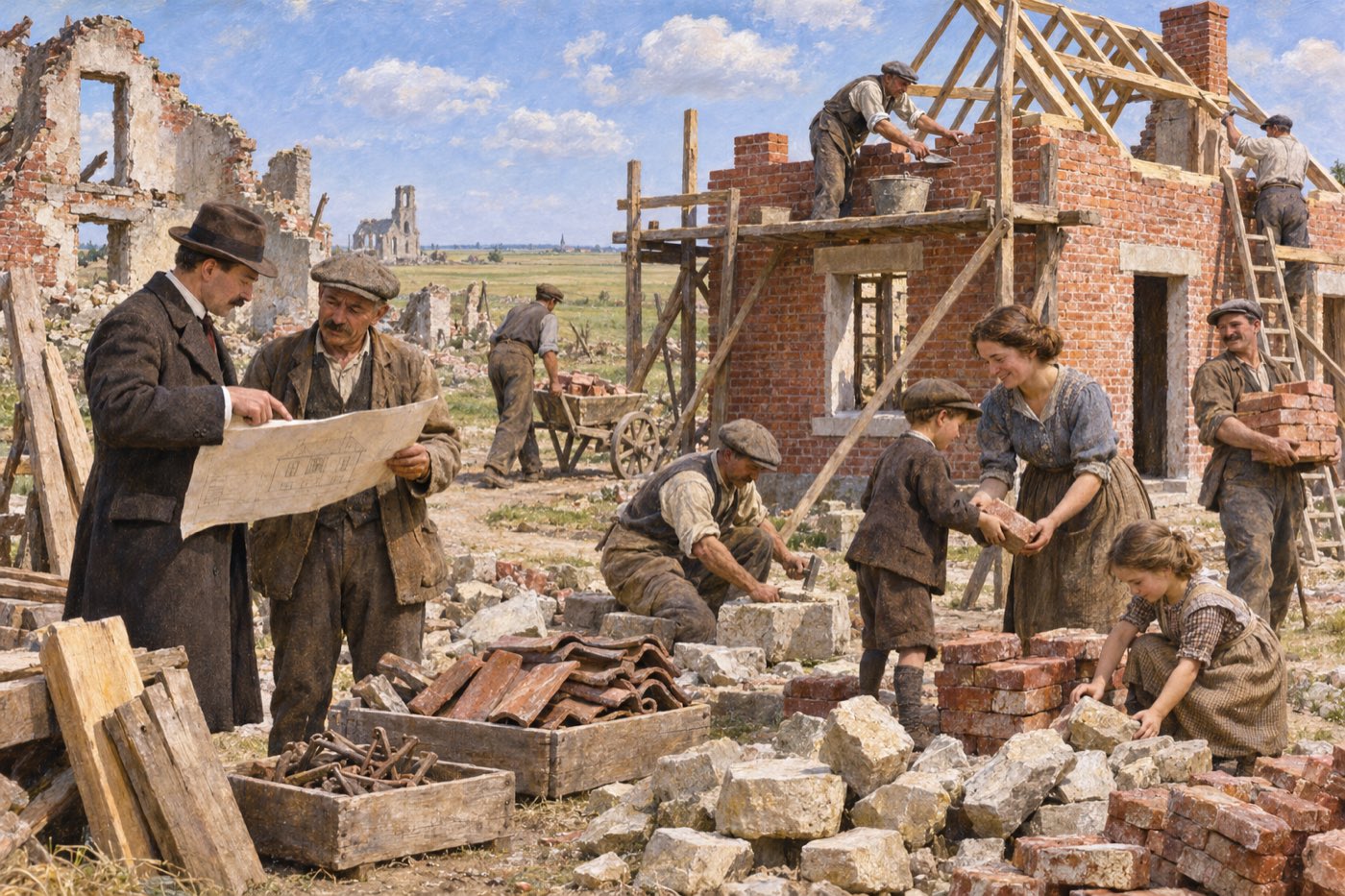
Rebuilding after the Great War: masons and villagers at work. Imagined illustration, not from the period. 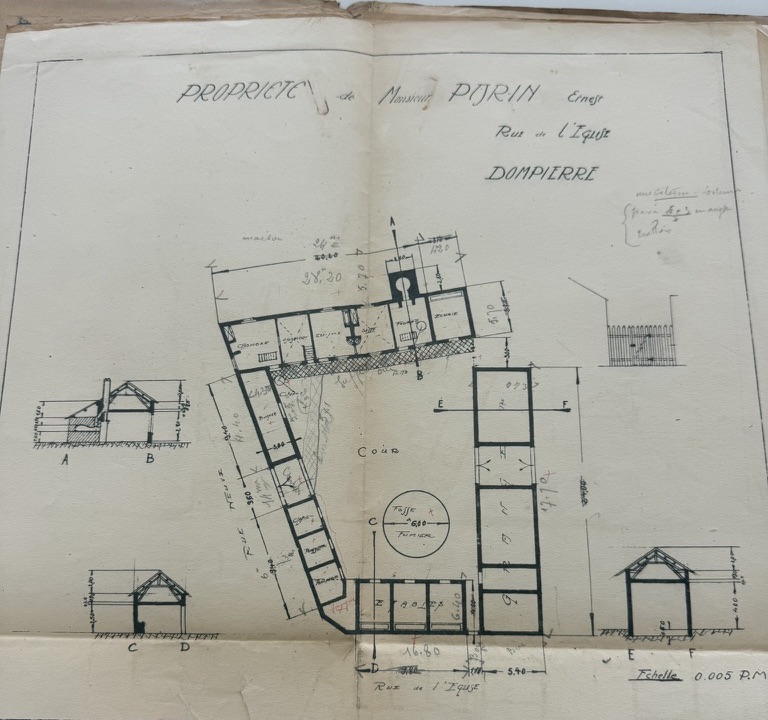
Plan of a farm on rue de l'Équse, drawn up after the war to assess the damage to be compensated.Archives départementales de la Somme Is your brick house or farm from the Reconstruction period? Its file may be kept at the Somme departmental archives, in series R (R for “Reconstruction”). There you can find the plans, the quotes, the exchanges with the architects and the authorities, and even details about the foundations.
- 1922 – 1923
The Sucrerie centrale du Santerre
Thanks to war damages from six destroyed factories, a brand-new sugar mill rises from the ground. It takes over the military railways to carry beets and sugar.
- 1924
Dompierre-en-Santerre
The commune changes its name and inaugurates its war memorial: a poilu ready to charge, perched on a pyramid-shaped stone.
- 1928 – 1930
A new church for Becquincourt
The architect Louis Poisson designs the church of Saint-Denis, in brick, with its so recognisable octagonal bell tower.
- 1937
The football club is born
The sugar mill's employees found the Football Club de Dompierre.
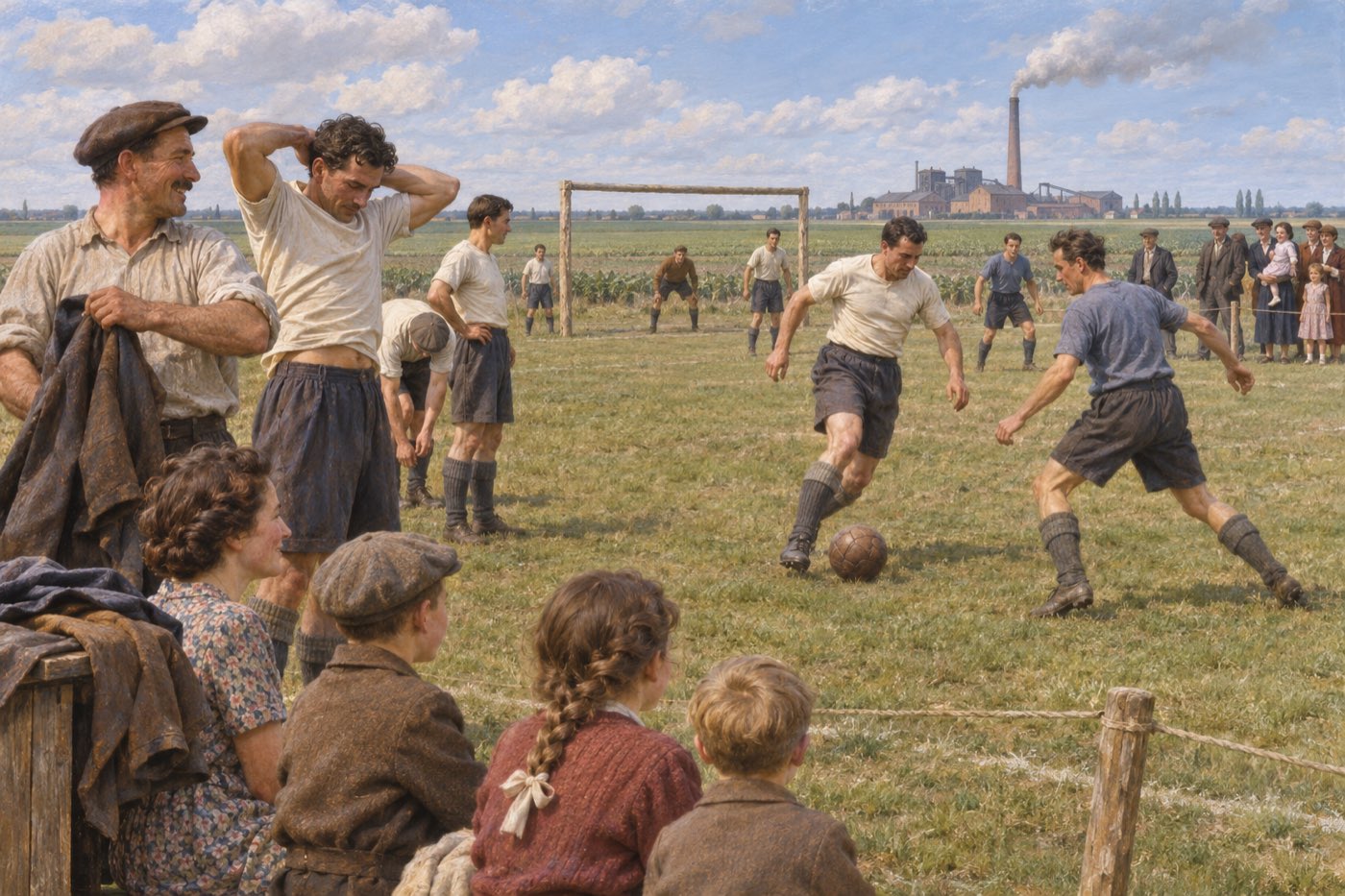
Amateur football around the sugar factory, around 1937. Imagined illustration, not from the period.
The Second World War
1939 – 1945- May–June 1940
The Battle of the Somme, again
The German army occupies the sugar mill and Becquincourt. The French 19th Infantry Division tries in vain to retake them.
- 1944
Parachute drops and the Resistance
In spring, several arms drops take place in the area. On 14 July, the inhabitants dare to hold a patriotic demonstration.
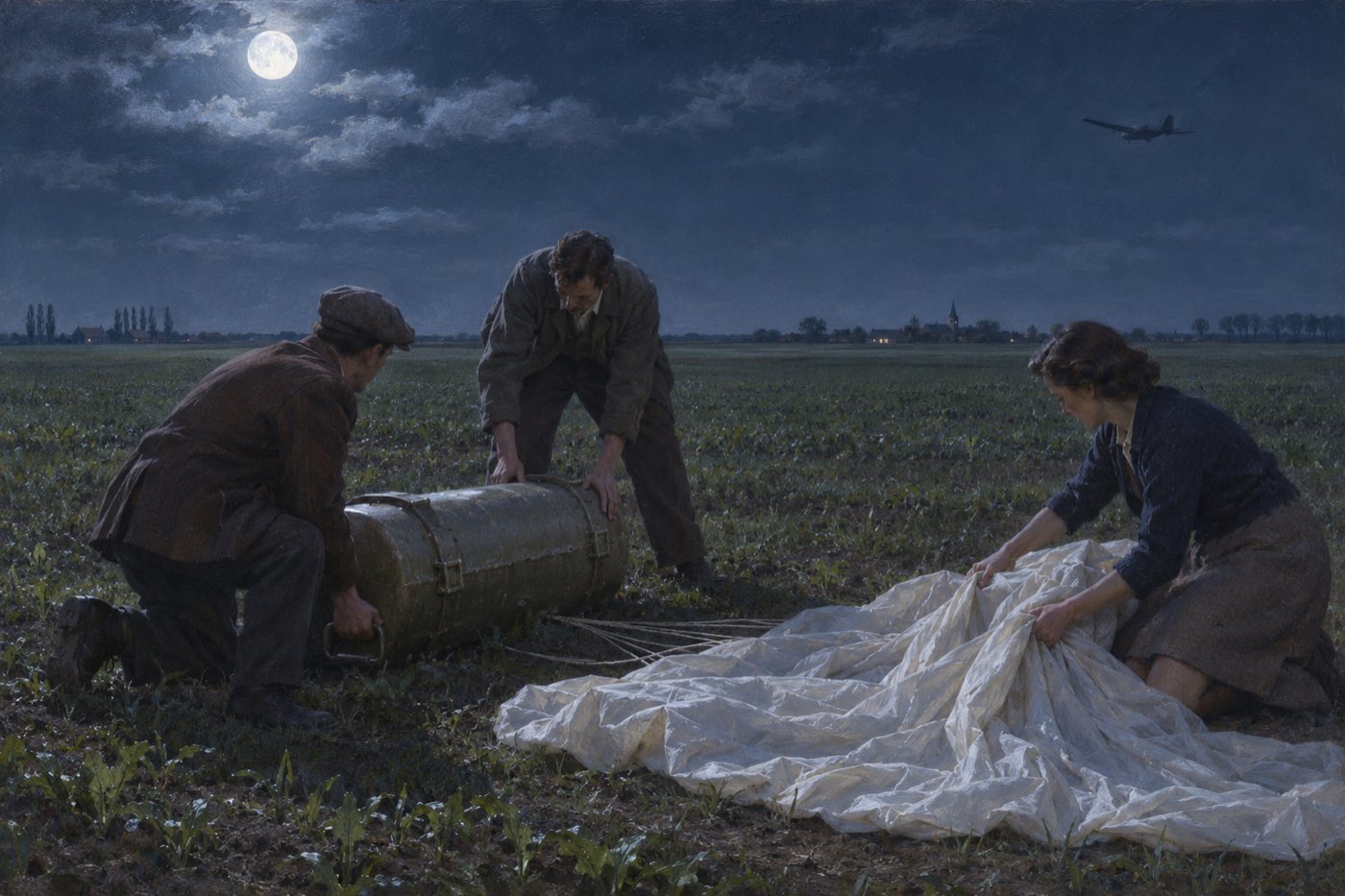
Clandestine parachute drop, 1944. Imagined illustration, not from the period. - Summer 1944
The price of courage
Several resistance fighters are arrested, including the mayor Paul Marchand, Raphaël Van den Bossche, Raymond Holmière, Marcel Gogibus and Roland Blondel. André Ghesquière is shot while trying to escape. Deported to Buchenwald on the convoy of 17 August 1944, several would not return: Paul Marchand dies in the night of 2 to 3 May 1945, during the evacuation of the camp.
From 1945 to today
Our times- 1964
Two villages, one commune
Dompierre-en-Santerre and Becquincourt merge: Dompierre-Becquincourt is born.
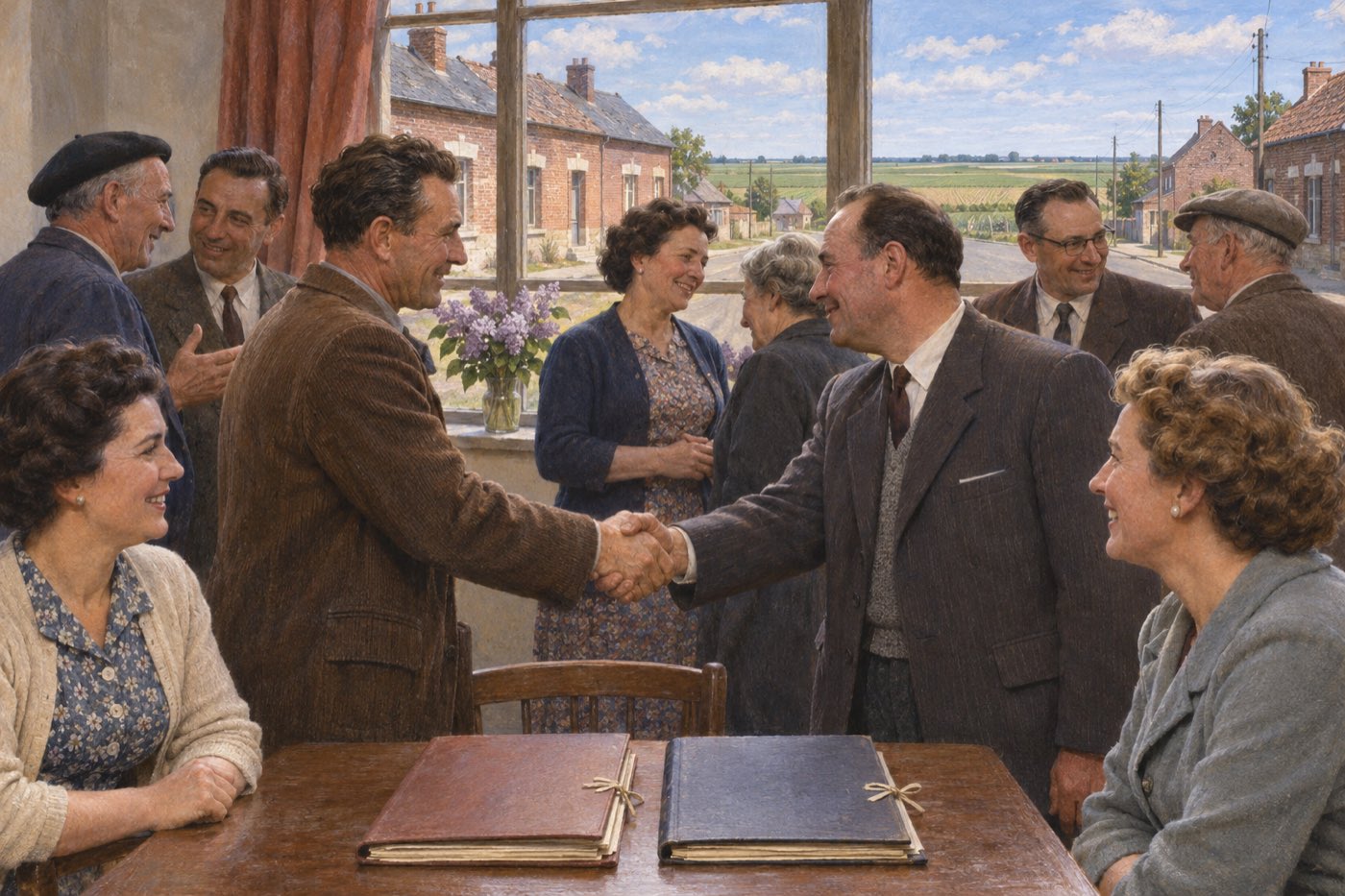
The union of the two villages into one commune, a symbolic evocation of 1964. Imagined illustration, not from the period. - 13 June 1971
The first tourist train
Enthusiasts run a train open to the public on the old sugar mill line: this is the start of the Haute Somme steam train.
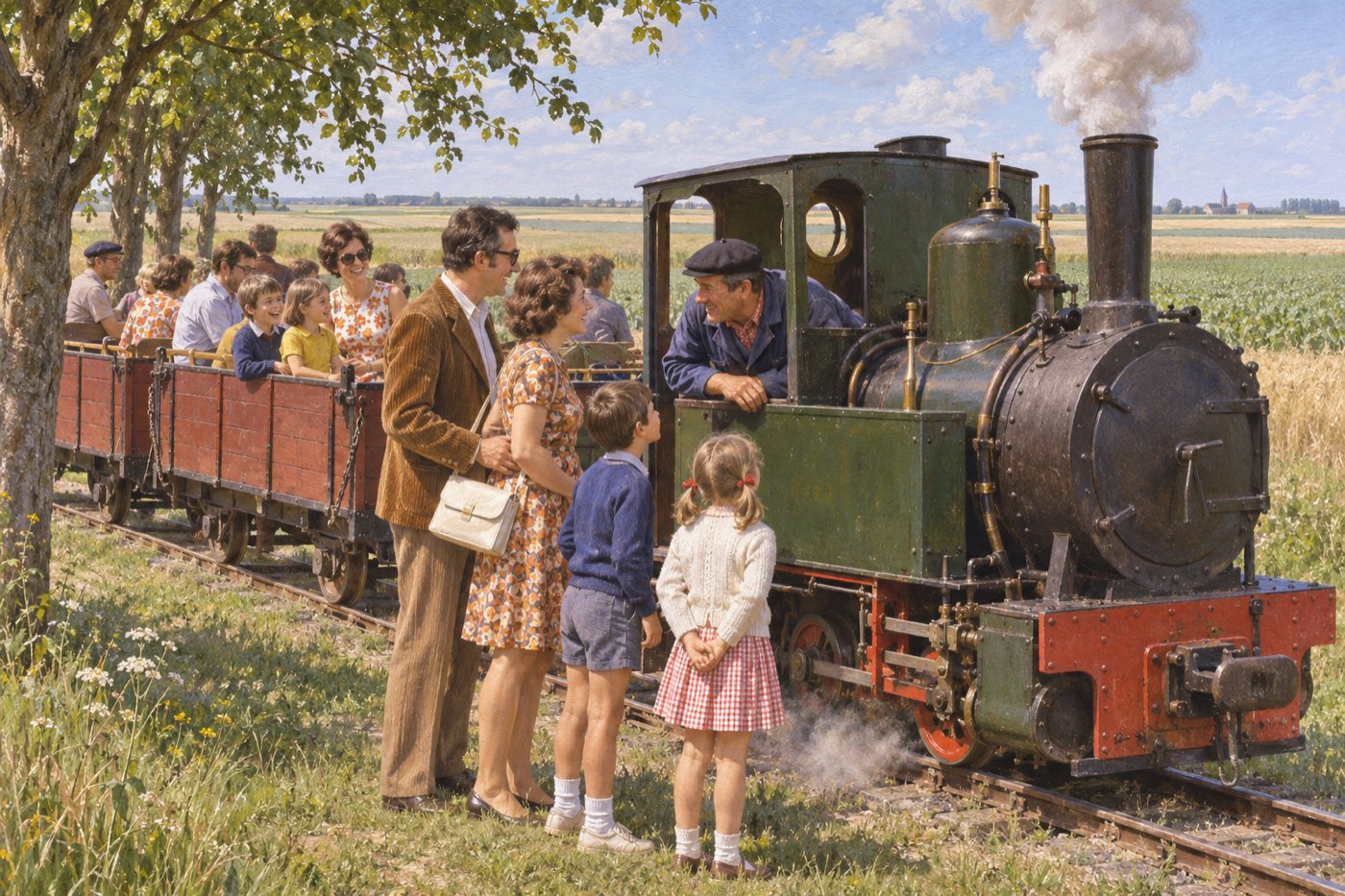
The beginnings of railway tourism, around 1971. Imagined illustration, not from the period. - 1988
The sugar mill stops
After 109 years of activity, the factory closes. The village becomes essentially agricultural again.
- 2019
Football starts again
The football club, dormant, is relaunched.
- 18 January 2023
From sugar to wine
The old sugar mill reopens, transformed into a winery: it now produces "Les 130", white wines of the Hauts-de-France.
"Dom-pierre, Domus Petri, the house of Peter: the priory was dedicated to Saint Peter."
According to local tradition
Do you know an episode of this history?
Family memories, school photos, old papers, anecdotes about the sugar mill or the Reconstruction: anything that can enrich the village's memory is welcome.